It has been ten days since my last post, and that's because I've been out most days, and have been struggling to find time to do a blog post. So, better late than never as they say! I've been carrying out some upland wader work on my client's farm, combined with some coastal migration monitoring, and a few walks down the Wyre estuary. The usual stuff.
Rewinding back to the 12th April, Gail and I had one of our regular walks along the Quay and estuary, but under cold grey skies, with a blustery south-westerly wind, and it was quiet. Hardly worth mentioning in fact, but we did have a Tree Pipit over, so that is perhaps worth a mention. We recorded a few plants flowering, including Dove's-foot Cranesbill, Red Valarian, Ribwort Plantain, Rue-leaved Saxifrage and Sticky Mouse-ear, and I am going to leave it at that. We had another visit to the Quay a couple of days later, and saw even less!
Over the past week or so, we have been having 1 or 2 Hedgehogs coming to our garden 'hog' feeding station, which is nice, but not so nice is a poor female Chaffinch regularly visiting the garden suffering with Fringilla Papillomavirus. Her legs look nasty with it.
Early last week, myself and a couple of RSPB colleagues, carried out the first of three breeding wader surveys at my client's farm in Bowland. It was a great morning for it, with 2 oktas cloud cover, and a light north-westerly wind.
Over our three survey sections, covering only half of the farm, we estimated:
Redshank - 3 pairs
Lapwing - 10 pairs
Curlew - 8 pairs
Oystercatcher - 7 pairs
Snipe - 1 pair
Common Sandpiper - 1 pair
Of course, there's a long way to go yet between where we are now, and successful fledging of chicks. We checked the two Lapwing nests with cameras on them, and both had been predated! The pair that I checked had started again in the field directly behind, so I'll keep my fingers crossed for them.
In addition to the waders that I surveyed, I also had a few other bits and pieces, including two Buzzards, 12 Brown Hares, ten Willow Warblers (9 singing), a female Goosander, a Raven, a Kestrel and a male Redstart.
The following morning, I was at the coastal farm fields and school close to home. I was hoping that the south-easterly wind would produce some birds, but the favourable wind direction was negated by the cold and clear conditions. As a result, I didn't record a single grounded migrant.
There was some visible migration, but it was light, and consisted of 282 Pink-footed Geese (94 north out at sea), seven Linnets, three Meadow Pipits, three Siskins and two Swallows. The sea was equally as quiet, with just 11 Eiders, a Guillemot, 24 Common Scoters, four Red-throated Divers and two Sandwich Terns.

At the end of last week, Gav and I were back in Bowland at my client's farm, looking for Lapwing nests to monitor with cameras. We found three active nests; 2 with full clutches of 4 eggs being incubated, and another with 3 cold eggs, which would be 4 the following day, and then the female would start the incubation. We put cameras on all three nests.
In the same field, we found another Lapwing nest with four cold eggs, with the remains of an adult next to the nest. All that was left was a leg and a few tail feathers. The bird didn't look to have been chewed, so this pointed to predation by a raptor, and also the eggs were still there, again pointing towards a raptor. I've included a few pictures below of the nests, and the predated Lapwing. That's how it goes sometimes.


Whilst we were searching for Lapwing nests, we had Snipe drumming in the same field, and a pair of Curlews engaging in some pre-mating display. All good stuff.
Close to the car, Gav heard the 'chack, chack' of a Ring Ouzel, and we then had a minute or two of pretty awful views of a male and female moving through the hedge. Nice though.
Saturday morning saw Gail and I back along the Quay and estuary. Another quiet one, although we did have 66 Redshanks, three Knots and two White Wagtails. The sun was out, and it brought out three Small Tortoiseshells and two Small Whites.


I ran my newly treated (see picture below) moth trap for just the second time this spring over that night and the following morning, and caught three moths of three species; Hebrew Character, Early Grey and Herald. Below are some pictures of the Herald, one usual shot, and a couple from different angles.


On Sunday morning, I had a bit of coastal migration action at the farm fields and school at Larkholme. When I arrived at first light, I had full cloud cover and it was calm. Shortly after I set up at my sea watching and vis location it started raining with a light drizzle, and it remained like that for the next three hours.
Surprisingly, given the drizzly and murky conditions, there was some vis, mainly in the form of hirundines, and heading in a northerly direction I had 16 Swallows (eight out at sea), an Alba Wag, a Carrion Crow, 3 Goldfinches, two Linnets, a White Wagtail and two Siskins.
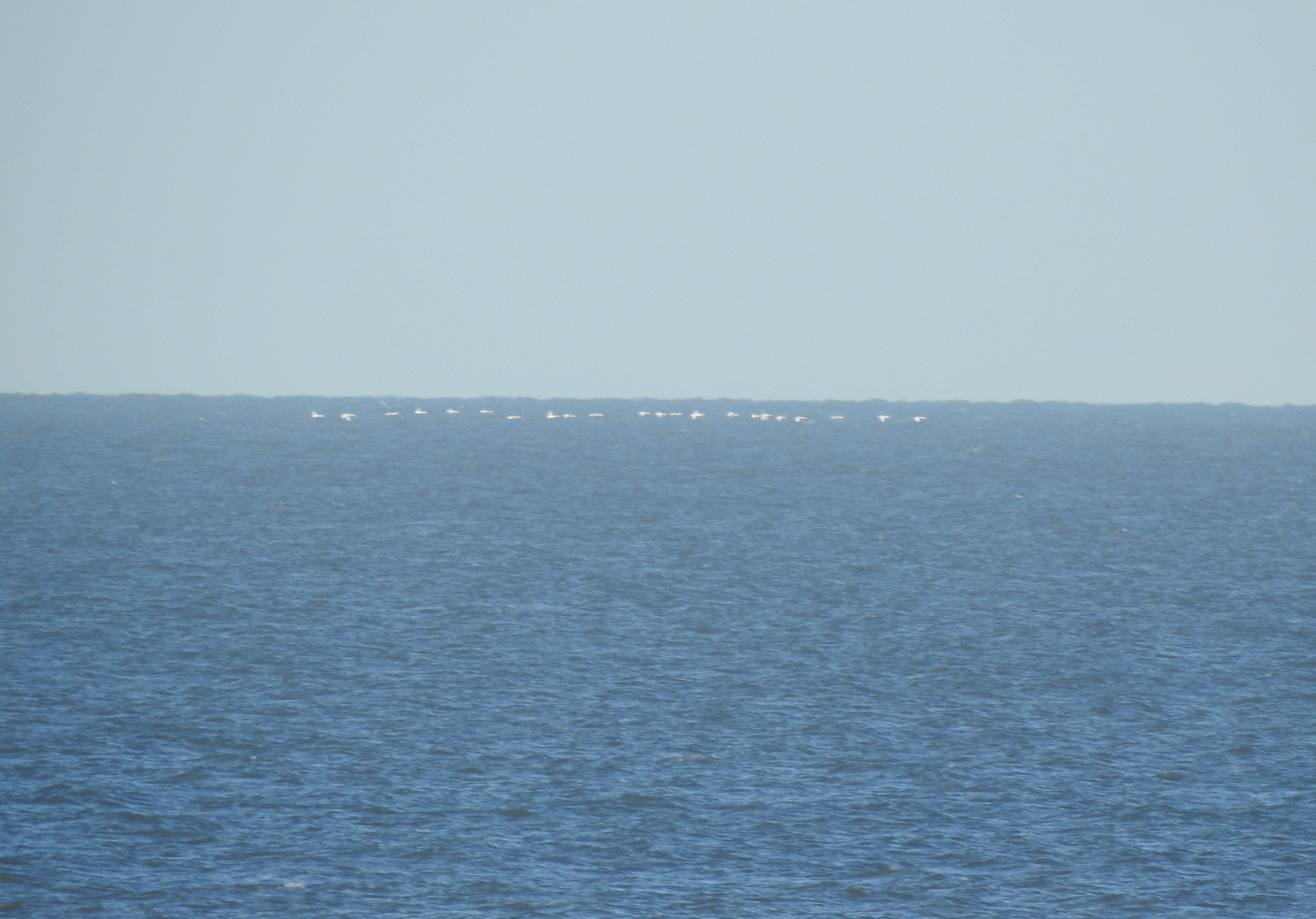
The sea provided the greatest interest, not in numbers, but in a first for me for the site. The sea was absolutely flat calm, just like a mill pond, and because of this, it was easy to pick out birds on the water. I had seen a group of three Teal, and when scanning left, I picked up another couple of dabbling ducks. Even with my scope, I couldn't properly make them out, although I had my suspicions. I pulled out my Nikon P950 and cranked it up to x83, and took an awful picture of the two ducks. However, when I zoomed in on the image on the back of the camera, I could make out the white crescent of a male Garganey! So, I suspect a pair of Garganey heading north had taken advantage of the calm conditions and dropped in for a rest.
In addition to the Garganey and Teal, the sea produced 25 Sandwich Terns, four Red-throated Divers, three Eiders, three Shelducks, 66 Common Scoters, six Cormorants and eleven Dunlin.
Whimbrel were also a feature of the morning. It started off by me hearing several calling birds that I couldn't see, so they had to go down in my notebook as singles, and then I had groups of 10, 6, 2 and three that tried to land on the beach, but decided against it. In total I had 24.

I had an odd selection of grounded migrants as well. I was busy looking down my scope when I thought I heard some Twite calling. At first, I dismissed it (I don't know why, as I have had them grounded in spring along here before), and then I looked round to see a group of six flying towards me on the inland side of the sea wall. They perched up on a wooden gate, and then dropped into the field to feed. After a short while they took off, and I lost them as they drifted east low over the field.

I then had some hirundines grounded. I say grounded, it was more of a case of the drizzle dropping four House Martins, that were then held low by the weather conditions, and spent the rest of the time I was sea-watching hawking aerial insects. To the grounded list I added a reeling Grasshopper Warbler, two Lesser Redpolls and two Willow Warblers. It was now time to head home.
It was pleasing, and probably more surprising, to read in April's British Birds, that both the British and Scottish Governments announced in January 2024, that industrial sandeel-fishing will no longer be permitted in English and Scottish waters. And about time too!
Lots of seabirds rely on sandeels for food, including Kittiwakes, Puffins, Guillemots, as well as marine mammals, such as Minke Whales, Harbour Porpoises and harbour Seals. This announcement will help in safeguarding the future of these species.