Wednesday, 16 May 2012

The Last English Hen Harrier?

I don't normally use my blog to report on news items in the biodiversity press, but I received an update email this morning from the Wildlife Trust that included a shocking piece on the fact that there is only one pair of Hen Harriers breeding in England this year and none so far in Bowland, just to the east of me. As I said before this really is shocking and this shouldn't be happening in England in the 21st century. It is time that we heard from DEFRA, Natural England and the British Government as to what they are going to do about this awful state of affairs. I know what I would do, but it isn't repeatable here.

Below you will find the article that shocked me this morning.

The future for England’s most threatened bird of prey – Hen Harrier – is looking bleak, as the species teeters on the brink of extinction as a breeding bird.
Early reports indicate that only one pair of the species is showing signs of nesting in England. If this continues it will be the worst year for Hen Harrier since it recolonised England, following extinction in the late 19th century. Worryingly, there are currently no birds attempting to nest in the Bowland Fells, Lancashire, the bird’s only stronghold in England in recent decades.
Martin Harper, RSPB Conservation Director, said: “Hen Harrier is noted for its wonderful rollercoaster display flight, but the bird’s population in England is on a rollercoaster ride itself. After recolonising England, the bird is now perilously close to being wiped out again as a result of decades of persecution.”
The RSPB’s Dr Andre Farrar monitored the species in the 1980s. Commenting on the situation today, he said: “When I started monitoring Hen Harriers, I had no idea that 2012 would be so bleak. When I started, the harriers were just establishing themselves in England after Victorian intolerance and extermination. Bowland has been their stronghold for decades – nesting attempts in other parts of England are infrequent and inconsistent. There are just too few of them in the English uplands.”
Andrew Gouldstone, a conservation manager with the RSPB in Lancashire, said: “The sight of Hen Harriers is one of the joys of spending time in the hills of Bowland. The RSPB has been working with its partners for over three decades to safeguard Hen Harrier nests here. Bowland is still a safe place for the bird but protecting them away from their breeding grounds is very difficult, and we may be about to lose them as a result.”
Government-commissioned, independent research has shown that the English uplands could support more than 300 pairs of Hen Harrier. The authors conclude that persecution associated with the practice of driven grouse shooting, is to blame for the harrier’s plight. Natural England has previously concluded that very few harrier nesting attempts are successful on grouse moors, there is compelling evidence that persecution continues, both during and following the breeding season, and persecution continues to limit Hen Harrier recovery in England. 
The Government has, via the England Biodiversity Strategy, committed to prevent human-induced extinctions of threatened species by 2020. The extinction of Hen Harrier as a breeding species for a second time looks unavoidable, unless an emergency recovery programme is put in place and there is a rapid and sustained reduction in persecution of these birds.
Martin Harper added: “DEFRA ministers have one chance to avoid breaking a promise. We’re doing everything we can, but the government and its conservation and enforcement agencies need to step up to the challenge of securing the future of Hen Harrier in England. The problem of illegal killing is well understood – we now need Government to bring solutions to the table.”
The situation has become so dire that the RSPB has relaunched its Hen Harrier hotline, to enable the public to report any sighting of these birds during the breeding season in England. The Harrier Hotline number is 0845 4600121 (calls charged at local rate). Reports can also be e-mailed to henharriers@rspb.org.uk.  Reports of sightings should include the date and location of sighting, with a six-figure grid reference where possible.

In fact you might have noticed that I have changed my 'header' to a picture of some young Hen Harriers that I had the privilege of assisting a very good friend of mine to ring and wing tag a few year's ago. Let's hope that they make a come back and long may Hen Harriers 'sky dance' over the moors of England.

Sunday, 13 May 2012

Boxing Day Again

I was at a friend's farm near Nateby this morning checking the 25 boxes that Diana and Robert have put up for Tree Sparrows. Out of the 25 boxes only three were occupied by Tree Sparrows, the rest by Blue and Great Tits. Interestingly there were more Tree Sparrows around the yard going into crevices in an old stone barn, so for next year Robert is going to put some boxes up on the barn wall.

On our walk round we had singing Chiffchaff, Willow Warbler, Blackcap, Whitethroat and Sedge Warbler. Over the flood 20 Swift were feeding with a supporting cast of House Martins, Swallows and Sand Martins.

Saturday, 12 May 2012

Boxing Day

This morning Gail and I headed up into Bowland to check our boxes in the Hodder Valley. We have 38 boxes up at this site with the aim of providing nest sites for Pied Flycatchers and other hole nesting woodland bird species. Out of 38 boxes we had 8 boxes occupied by Pied Flycatchers, 8 by Blue Tits, 6 by Great Tits and one by Nuthatch.

The Hodder Valley

I lifted a female Pied Flycatcher off the nest from one box and she was ringed and on checking on the computer back home I had ringed her as a chick out of one of the boxes at this site in 2010. We also ringed a brood of 8 Nuthatches.

Nuthatch

Walking through the woodland we had singing Blackcap, Garden Warbler and Willlow Warbler. Other birds included Jay and a calling male Tawny Owl. Orange Tip and Green-veined White Butterflies were on the wing and plenty of woodland plants were flowering including Bluebell, Wood Anemone, Ramsons, Herb Robert, Lesser Celandine and Bugle.

 Bugle

Heading back to the 'flatlands' of the Fylde we checked our boxes on Rawcliffe Moss where we just have 14 up at this particular site for Tree Sparrows. Out of the 14 boxes 12 were occupied and we ringed two broods of four. There should be plenty to ring next week.

 Tree Sparrow

I wanted to take this opportunity to tell you about a new blog that I have set up with my good mate Ian Gardner (in fact it is Ian that does most of the birding at the obs) called Fleetwood Bird Observatory (click to access) which details the daily bird movements through what we call the 'obs'. It is in its infancy at the moment and will change, so please bear with us until we have got it right.  

Sunday, 6 May 2012

Two 4 One

Yesterday I had a walk round the 'obs' in the cold northeasterly wind, in fact at 5.30 a.m. there was a ground frost. Even though it was cold there were a few birds on the move and all I had were 47 Goldfinch, 6 Swallows, Tree Pipit, 4 White Wagtails, 6 Lesser Redpolls, 28 Linnets, 3 Siskins, 2 Sand Martins, Meadow Pipit, 2 Whimbrel, Alba Wag and Yellow Wagtail.

 Goldfinch

There were a few more warblers in on territory including the regular Lesser Whitethroat plus 3 Whitethroats and 4 Sedge Warblers. The only grounded migrants as such were two female Wheatears.

 Sedge Warbler

The sea was fairly quiet but I did have an addition to the site for the year in the form of a Little Tern rapidly heading north. Other 'stuff' on the sea included 15 Eider, Atlantic Grey Seal, 2 Cormorants, 35 Gannets, 10 Arctic Terns, 15 Auk sp., Red-throated Diver and 2 Sandwich Terns.

This morning Ian and I had a ringing session in the reedbed and we processed 11 new birds (recaptures in brackets) as follows:

Lesser Whitethroat - 1
Whitethroat - 2
Lesser Redpoll - 1
Mealy Redpoll - 2Y female
Sedge Warbler - 3
Chaffinch - 1
Reed Bunting - 1 (1)
Goldfinch - 1
Great Tit - (1)
Reed Warbler - (2)

Reed Warbler

The view from a birding perspective from the ringing station in the reedbed isn't brilliant but we did manage to have Whimbrel, 4 Black-tailed Godwits, Siskin, Tree Pipit and 6 Lesser Redpolls.

Thursday, 3 May 2012

A Reasonable Morning In A Quiet Sort Of Way

I was hoping to do some ringing at the 'obs' this morning but the wind forecast last night was just a little to strong for our coastal site. So instead I was out at 5.30 a.m. giving the obs a good grilling by birding only. I had clear skies with a 5-10 mph northeasterly wind.

A couple of Willow Warblers feeding quietly in some Bramble gave me the feeling that there might be a few grounded migrants around on the quiet. I added a further 3 Willow Warblers on my search and a singing Wood Warbler definitely made me think there could be a few grounded birds about. Unusually the Wood Warbler was feeding along the central hedge and giving short bursts of it's 'trilling' song every so often. I came back along this hedge a couple of hours later when it had warmed up but there was no sign of the Wood Warbler.

Other grounded birds included 7 Wheatears, 2 Sedge Warblers, 3 Whitethroats and a single Lesser Whitethroat.

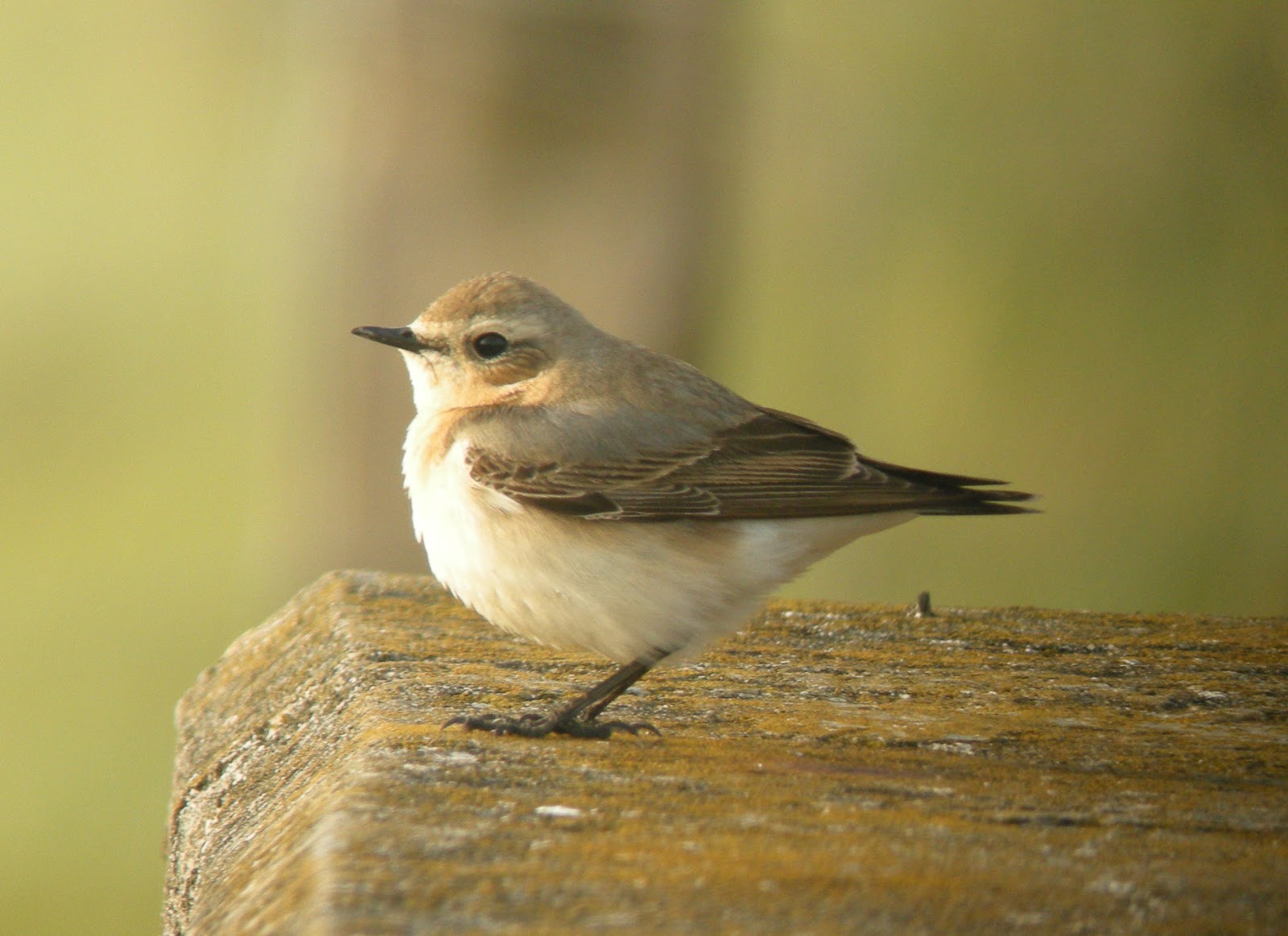
 Wheatear

There was some 'vis' this morning, though not as heavy as recent mornings, and I had 2 Woodpigeons, 30 Linnets, 44 Goldfinch, 4 Siskins, 396 Swallows, 12 Lesser Redpolls, 7 White Wagtails, 2 Tree Pipits, 3 Alba Wags, 5 Whimbrel, Meadow Pipit and 19 House Martins.

It was fairly quiet on the sea, although I did record a couple of 'firsts for the Spring for the site', and I had 15 Cormorants, 13 Gannets, 13 Sandwich Terns, 4 Auk sp., 24 Arctic Terns, 5 Eiders, 6 Common Scoters, 3 Red-throated Divers, 2 Teal, 4 Red-breasted Mergansers and 4 Manx Shearwaters.

Wednesday, 2 May 2012

Mossy Morning

I had an hour to spare before my first site visits and as I was heading east I thought I would have a walk round Rawcliffe Moss as it's been a while since I was here. As soon as I got out of my car I could hear Corn Bunting singing from the field behind me and Blackcap and Willow Warbler form Curlew Wood. On my walk round I recorded 6 singing Corn Buntings and 4 singing Blackcaps.

Along the feeding 'station hedge' were 12 Linnets and 7 Goldfinch and they were flying down into the adjacent field to feed on Dandelion seeds. I walked up the '97 hedge' and didn't record very much until I got to the Tree Sparrow boxes and there was plenty of activity around these. In total I had 18 Tree Sparrows, including 5 around Curlew Farm.

The plantation held sinigng Garden Warbler, Sedge Warbler, 4 Willow Warblers and Whitethroat, and on the top fields was a single Whimbrel. Heading back to the car I picked up a Siskin, Great Spotted Woodpecker and 2 Mistle Thrushes.

The only pictures I got this morning, after some failed attempts at Corn Bunting and Tree Sparrow, were of Red Dead-nettle and Lesser Stitchwort below.

 Red Dead-nettle

Lesser Stitchwort

I got a phone call from Ian later on saying that he had had a good morning at Rossall with 9 Poms, 4 Black Terns, 11 Arctic Skuas and plenty of Arctic Terns. Nice!

Tuesday, 1 May 2012

Leftovers

Yesterday was probably one of the best, if not the best, day of the Spring so far. However, I was working and therefore couldn't get out to the coast to enjoy it. I was land-locked carrying out a breeding wader survey, but I shouldn't complain as there are worse ways to earn a crust on a Monday morning! Today was earmarked as an office day for me and I decided to spend a couple of hours birding at the 'obs' before a day of report writing.

At 5.30 a.m. I had full cloud cover with a moderate northeasterly wind as I set off on my walk. Immediately I had a singing Willow Warbler and in total I had three by the end of my session. Other grounded birds included 2 male Whinchats and 23 Wheatears.

 Willow Warbler

Swallows were the most numerous species moving this morning and I had 487 in total battling their way north. There was quite a good 'vis' passage this morning and in addition to the Swallows I had Woodpigeon, 2 Tree Pipits, 9 Lesser Redpolls, 11 Meadow Pipits, 20 Linnets, 9 Siskins, 19 White Wagtails, 25 House Martins and 104 Goldfinch.

The sea was relatively quiet with just 18 Whimbrel, 2 Shelducks, 14 Sandwich Terns, male Eider, 2 Gannets, 3 Cormorants, 20 Common Scoters and a Razorbill. A telephone conversation with Ian at the Point during the morning informed me that I had missed Marsh Harrier and Osprey!

I am out working in the field tomorrow, but hopefully I might be able to get out ringing Thursday morning with a little more birding on Friday. As always I'll keep you posted.