Friday, 18 December 2020

Temporary Patches

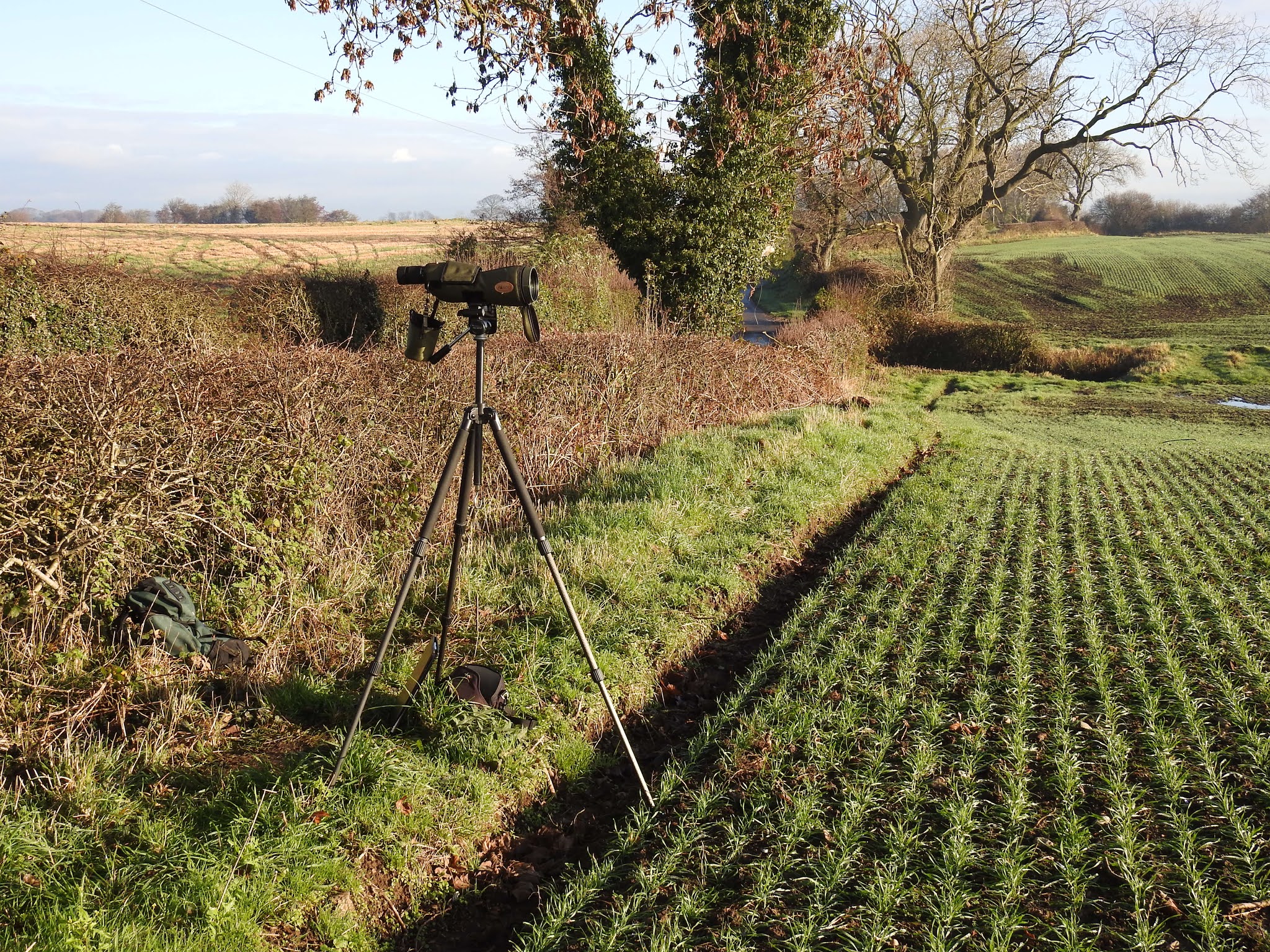
It's funny how quickly a site that you are undertaking a series of wintering bird surveys at, becomes almost like a patch. It will usually be a site that you have never visited before, it might not be the best site in the world, but after you have completed somewhere in the region of twelve surveys, with a minimum of 36 hours observation time, it becomes familiar, you get to know it fairly intimately, and you sort of, start getting patch ticks. And then it's over, the survey period has finished and you never return. I like to call them temporary patches.
 
I have one such patch this winter in west Lancs, and I have mentioned it before, it's the one with a bit of a marsh. I was there earlier in the week, on a reasonable morning with three oktas cloud cover and there was a light south-easterly wind. I also had a patch tick too! 

I walked along the busy road to where I access the site down a bramble covered embankment and on to the first, now quite wet, arable field. It's always a relief to get away from the road, as the noise from the traffic does actually hurt my ears. There's a bit of a ruined orchard that I walk past, orchard might be too strong a word as there is literally a couple of apple trees, and a Song Thrush called from here, barely audible above the traffic noise.

I dropped down onto the field, and a number of Pink-footed Geese flew overhead, 128 to be precise, and then I headed north along the edge of the marsh to my VP. As usual I could hear Teal, Mallards, Moorhen and Water Rail calling, but it was the bird perched up on some Bramble and Willowherb stems that drew my attention. A male Stonechat, and a new species for this temporary patch! Another bird flew past me low, perched up, and it was a female Stonechat. So, a pair of Stonechats new to my temporary patch and I was made up!
 
Stonechat (male above & female below)


There were a few birds on the stubble field again, including 138 Woodpigeons, 74 Black-headed Gulls, 53 Herring Gulls, twelve Fieldfares, 86 Starlings and three Stock Doves. A Buzzard, and a female Sparrowhawk were causing a bit of mayhem this week over the stubbles. 
 
I've got one more survey to get in, and that's me finished for the Solstice festivities until the New Year. Fingers crossed for some decent weather to get out birding or ringing, or maybe even both!

Wednesday, 9 December 2020

First Snow

This post is really just to report, that I haven't really got anything to report! And once again, it's down to the weather.
 
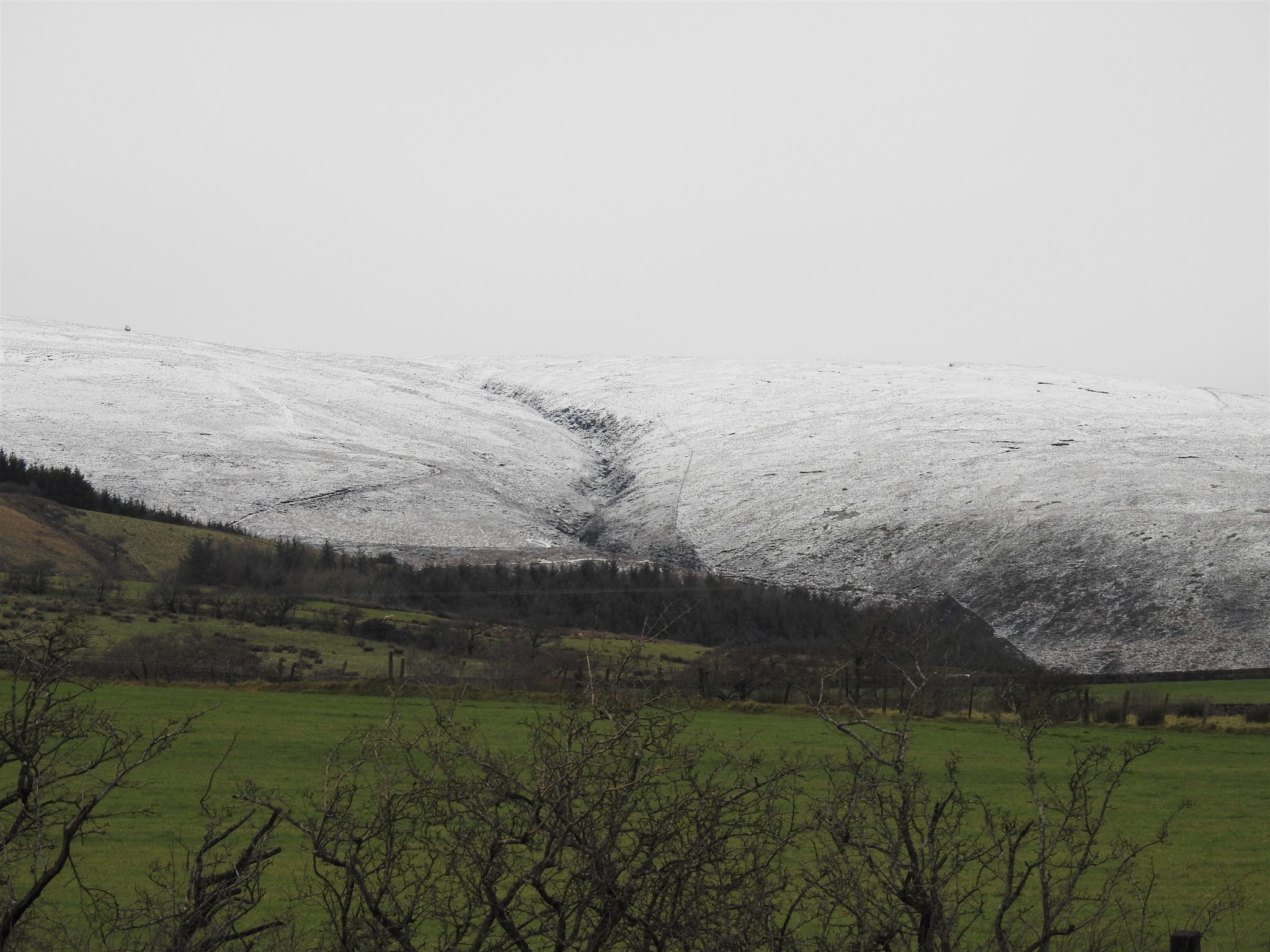
Towards the end of last week, we had our first snow. On the Friday, I headed to my feeding station in Bowland, and there was a sprinkling of the white stuff on the fells. Whilst I was at my feeding station topping the feeders up it was snowing there too, but it wasn't quite cold enough for it to settle. 
 
A sprinkling of snow on the fells (above & below)


The feeders were duly re-filled, seed scattered on the ground for the ground feeders, all ready for a ringing session on Sunday morning. Sunday morning came round, and I met up with Alice, and it was raining! Not the sort of rain that would trouble you if you were out for a walk, or birding on the hoof, but it was the sort of rain that is impossible to ring in. 

Instead, we had to settle for a walk. We didn't really see a great deal, there was the usual Coal Tits, Nuthatches and Chaffinches visiting the feeders, and a couple of Great Spotted Woodpeckers in the woods. A few Goldcrests called from some conifers, and a Raven flew over croaking. A Buzzard and a Redwing later, and that was it. That's two weekends in a row where the dreich weather has prevented us from doing any ringing. And the forecast isn't looking great for the coming weekend either, but never mind, the Solstice will be upon us soon and we can look forward to the return of the light.

Today I was at one of my wintering bird survey sites in west Lancashire, the one with a bit of a marsh. My survey period was from mid-morning to early afternoon to cover the low tide period, and it was quiet. The first entry onto my maps was a Roe Deer that slipped round the end of a hedge and along the edge of the marsh. The only other mammal that I recorded was a Brown Hare that I flushed from a drier bit of the marsh where it abuts an arable field. The male Kestrel was in residence, and I saw him in a variety of locations; perched up on power lines, hovering over the marsh and keeping watch from some Willows surrounding a pond. 
 
Brown Hare
 
Talking of raptors, I had a Buzzard that kept on upsetting the Starlings, Fieldfares and Woodpigeons that were feeding in a stubble field, by flying backwards and forwards over them to some woodland, but most interesting was the female Sparrowhawk hunting over the marsh. I don't know whether she had become a bit of a Snipe specialist in terms of her prey selection, or perhaps even Teal, as I suspect she was capable of tackling Teal, but she was flying back and forth over the marsh flushing Snipe and giving chase. I never actually saw her catching any, but she certainly gave me the impression that she had done this before, and it wasn't just pure opportunism.

The marsh is a bit frustrating as I don't really know what is on/in there in terms of numbers. I hear Mallard and Teal calling, but how many I don't know, and I entered two Water Rails on to the maps based on calls from different parts of the marsh, but there could well be more than that. 

I mentioned Fieldfares and Starlings before in relation to the Buzzard, and I recorded 32 of the former and 435 of the latter. I had a Raven go over, and I only mention it because I like Ravens, as a single Raven these days isn't as exciting as it used to be in this part of the world when I was a nipper. 
 
Behind my second VP there is a ribbon of woodland alongside a burn, and I had a couple of Grey Wagtails close to this area. A flock of 49 Goldfinches were feeding on Ash seeds, and in fact they were virtually above my head, but were feeding quietly and it was only when they flew and called that I knew they were there. A party of eight Long-tailed Tits bounced from the hedge and across to the woodland. I think last time I was at this VP a couple of weeks ago, they numbered fourteen, but then again, they could easily be different birds. 
 
This Robin (above & below) kept me company at my second VP


 Although it was quiet, it was a pleasant way to spend a few hours working. As I hinted at before, the weather isn't improving anytime soon, and I will struggle to get another survey in before weekend, but I always live in hope!

Thursday, 3 December 2020

Tundra Bean

Earlier in the week I was back at one of my wintering bird survey sites in West Lancashire. The conditions were perfect with four oktas cloud cover and a light northerly breeze. Two of my VPs are from my car, parked in a layby on a busy A road. However, the fields to the east of my VPs can be good for wintering Pink-footed Geese, and I do watch them as they are close to home.
 
Pink-footed Geese
 
When I pulled into the first layby, I could see that there was already some Pinkies feeding in the field. Over the next hour, small numbers kept dropping in, and in total I counted 618. On a couple of occasions, I thought I had a Tundra Bean Goose, but it was distant and I kept losing it. Later in the morning I moved round to another location overlooking the next field along from the geese, but I could still see them through some gaps in the hedge, and they were a lot closer. I had just got my scope on the Pinkies through the gap in the hedge and a Tundra Bean popped its head up. A lot closer now, and no mistaking it, so my original thoughts were correct. Unfortunately, they were just too far away for a photo that would make any sense. 
 
Only two raptors here, a Buzzard and a Kestrel. The Buzzard flew in and perched on top of a pylon, and one of the local Kestrels took offence at this and mobbed the Buzzard, but the Buzzard wasn't for moving! 
 
Kestrel
 
At another section of my survey that involves a transect over some rank grassland and scrub, a Sparrowhawk was perched on top of a building with a Magpie escort. After a few hard stares from the Magpies, the Sparrowhawk was off, and surprisingly it didn't receive any further attention from the black and white bandits. I like Magpies. And I like Sparrowhawks.  

It seemed like there had been an influx of Blackbirds over these past few days, as I recorded 15 during my survey, and that is a good number for this site. Reading various east coast bird blogs etc over the past week, and a number of them have been reporting an influx of Blackbirds and Redwings, so that fits in with the west coast always being several days later for the birds to arrive here. 

A calling Chiffchaff from the mature hedge was probably the same bird that I recorded here about ten days ago, and is probably over-wintering. I suppose if I record it over the next couple of visits I will know for sure. 

I saw an unusual bird perched, well awkwardly stood really, in a Hawthorn this morning in the form of a Moorhen. It had flown/clambered up into the Hawthorn to reach some rose hips on the rose sp. that was using the Hawthorn as scaffolding. What made me laugh was the way it attempted to walk through the Hawthorn flicking its tail and bobbing, as if walking along the ground.

The Snipe were in the usual position roosting on the Bramble covered concrete hard standing, and the picture below shows where they are roosting by the number of droppings on the ground. 
 
Snipe poo!
 
The weather didn't play ball last weekend, and it was dreich at best, and not good for any ringing at my Bowland feeding station. I did call to the top feeders up however, and caught the Roe Deer in the picture below taking seed from one of the feeders! The feeder was obviously at perfect deer height! 
 
Roe Deer
 
I am hoping that the weather will be okay for this coming weekend, and that we can get some ringing done.

Friday, 27 November 2020

Standing Still

Standing still is something that I do a lot of, particularly when out working undertaking bird surveys, especially if vantage point (VP) counts are involved. One of the things that I like about standing still for some time, is that the birds, and other wildlife, will come to you. I have a wintering bird survey site in west Lancashire and this includes two VP watches, so I have a lot of standing still going on there. 

The site is mainly arable farmland, with over-managed hedges, but there is a pond or two, a strip of woodland, and a wet marshy area of about nine hectares. This wet area has obviously been too wet, and expensive, to drain in the past, so it has survived. I'll refer to this area as 'the marsh'. 
 
You can see the typical habitat from this picture of my second VP location
 
I would love to have stood in area like this a hundred years ago or more, to see what wildlife approached me. The marsh would have been a lot bigger then, and the arable land surrounding me would have been winter stubbles rather than the winter wheat that it is now. It would have been thriving. Now the landscape is denuded of biodiversity, but nevertheless standing still, does afford some interactions with what is left of the local wildlife.

During this past week I have visited this site three times, and over the winter between now and early April, I will visit it a further nine times, so it will be interesting to note what I see. Below are a few highlights of what I observed over all three visits just by standing still.

Raptors have been present this week, and a couple of the local Buzzards and a male Kestrel have caused havoc with the large-ish flock of Woodpigeons (300+) feeding in a large stubble field behind my second VP. However, my best raptor sighting was that of a female Marsh Harrier, that spent an hour one morning hunting over the marsh. She quartered back and forth, turning on sixpence, and dropping into the vegetation, presumably on prey. 
 
Buzzard
 
Talking about the marsh, I don't doubt that it was stuffed full of Snipe. As I walked along the edge of it and an arable field, I put up nine Snipe, and I imagine that if I could have walked across it, I would have recorded ten times that number, with an odd Jack Snipe thrown in for good measure. 

One morning from my first VP closest to the marsh, I had a Green Sandpiper drop in and this was against a backdrop of calling Teal and at least two squealing Water Rails. Not bad for a small inland marsh.  

Green Sandpiper

In a couple of fields some Starlings were feeding, and I had 713 in total. Accompanying them were a few winter Thrushes, in the form of 85 Fieldfares and 28 Redwings. A Song Thrush and a Mistle Thrush added to the Thrush tally. 

I expected to see more Pink-footed Geese flying over, heading to foraging areas from their coastal roosts as my surveys were from first light, but I only had 189, and a single Whooper Swan headed south one morning. 
 
 Pink-footed Geese

I was joined by another Ecologist one morning, and we watched a Grey Heron fly over. He commented that he liked herons because they are the most 'dinosaur looking' of birds! And he is right. Talking of how birds look, I picked up a wader in the distance flying towards me and it looked odd. When it got closer, I could see that it was an Oystercatcher with an extended down-curved upper mandible. It was obviously not causing too much of a hindrance, as it must have managed to feed and survive thus far. 

Two days running I could hear, and see the odd Long-tailed Tit flitting along one of the hedges and the edge of a strip of woodland, but it wasn't until this morning that I could finally count them. They came along the hedge that I was standing in front of, and I positioned myself between two Ash trees and counted fifteen bounce by. Cracking little birds! 

The best of the rest included a Grey Wagtail, three Stock Doves, 20 Lapwings, two Great Spotted Woodpeckers, two croaking Ravens and a couple of Goldcrests. Not too shabby for standing still in some fairly typical farmland habitat.

Fingers crossed for some ringing at my Bowland feeding station on Sunday, and if the weather plays ball perhaps a look on the sea tomorrow. I say if the weather plays ball, because for both days the dreaded 'black cloud' is forecast, and generally that means rain. But we'll see...

Saturday, 21 November 2020

High Water versus Low Water Counts

Like a lot of wintering bird surveys, where the land being surveyed is potentially functionally linked to a Special Protection Area (SPA), Vantage Point (VP) counts are required both over the high and low water periods for each month surveyed. One of my wintering bird surveys requires such counts, and earlier this week I had the opportunity to compare both.
 
This particular site isn't overly exciting, but when I was there at the beginning of the week the influence of the Spring tide was obvious, as the 10.0 m tide pushed birds inland. At my second VP at this site, I recorded 312 Lapwings, 31 Redshanks and four Snipe. At the same site, and VP, three days later over a low tide, I recorded just 2 Lapwings. This pattern will be repeated throughout the winter, and it will be interesting to see how the numbers and species' composition change. 
 
Lapwings (above & below)


Rewinding back to the start of my survey at the beginning of the week, my first VP location was over an area of rank grassland with adjacent scrub. I didn't record anything from/over the rank grassland other than two Grey Wagtails that chased each other past me. 
 
A few birds were in the scrub, and first up was a male Great Spotted Woodpecker perched high up in some Birch. A male Sparrowhawk shot into the scrub, with one of those disappearing acts where you thought "did I just see a Sparrowhawk"? A party of ten Long-tailed Tits, like monochrome pom-poms, bounced from branch to twig, and bush to tree, and away past me, like a flurry of snow; magic. Two Mistle Thrushes were the only other species that made it into my notebook from this particular section. 

Raptors were thin on the ground throughout the morning, and all I could add to the Sparrowhawk was a Kestrel later in the morning. 
 
Distant Kestrel
 
My low water count later in the week kicked off with two male raptors, a Kestrel and Peregrine, but it never really got going. Two Mistle Thrushes and three Redwings were noteworthy, as was a calling Reed Bunting from a small area of reed. Two further Mistle Thrushes, and their Song Thrush cousin, and two more Reed Buntings were recorded from a different section of survey.

Part of my survey includes an area of scrub covering a section of former buildings, now demolished, and associated Bramble covered concrete areas. Every time I climb the gate and walk across this area, I always put up two or three Snipe, and today was no exception. This is the third time that I have walked across this bit and put the Snipe up, so it is obviously a day-time roosting spot for a few individuals.

The weather has been pretty awful of late, and I have struggled to get out, but it is looking a bit more settled later on next week, so hopefully I can do a bit, and maybe also get some ringing in at my Bowland feeding station.

Friday, 13 November 2020

Tweedler

I have a few wintering bird surveys to complete over the coming months, and I completed my first visit to a site in northwest Lancashire yesterday. The weather was a bit 'hit and miss' at first, with a few blustery showers, but as the morning progressed the weather improved. 

At first light I was stood adjacent to a large hedge over-looking some rough grassland and scrub. A few Redwings exited the scrub at first light, heading out to forage for the day, and four Snipe dropped in, with their feeding rhythms at odds to the Redwings. The Snipe will have been dropping into the site to roost, after feeding somewhere suitable overnight. A Chiffchaff called from the hedge behind me; a late migrant or an over-wintering bird? 

I recorded little else of interest other than perhaps a couple of Song Thrushes and singles of Siskin and Mistle Thrush, all utilising the scrub.

The second part of my survey was in some more open landscape, so a Great Spotted Woodpecker 'bouncing' along was a surprise. But the best bird of the morning was the Tweedler. Tweedler is an old Lancashire name for Merlin, but none of the sources that referenced the name could explain why the Merlin was known as Tweedler in Lancashire. I picked up the female Merlin on the ground in a field, an odd place for a Merlin, but I can only assume that she had been on prey. She was busy preening away and was there for a good twenty minutes before being flushed by a Carrion Crow. Later when carrying out some observations from my car, I saw her head south, over some woodland and away out of sight. So, a quiet morning, but all the brighter for the Tweedler.
 
A young female Tweedler from a nest site in an upland area of Lancashire

Over on the right you will see that I have updated the ringing totals for Fylde Ringing Group up until the end of October. Only one new species for the year was ringed in October and that was Fieldfare, and to be precise we ringed three of them. Below you will find the top four species ringed during October, and the top ten 'movers and shakers' for the year.

Top 4 Ringed During October

1. Redwing - 80
2. Greenfinch - 53
3. Long-tailed Tit - 14
4. Goldfinch - 11

Top 10 Movers and Shakers

1. Linnet - 128 (same position)
2. Meadow Pipit - 116 (same position)
3. Greenfinch - 107 (up from 9th)
4. Willow Warbler - 93 (down from 3rd)
5. Redwing - 88 (straight in)
6. Blue Tit - 87 (down from 4th)
7. Pied Flycatcher - 73 (down from 5th)
8. Great Tit - 70 (down from 6th)
9. Goldfinch - 65 (up from 10th)
10. Sand Martin - 63 (down from 7th)

Saturday, 7 November 2020

A Splash Of Late Autumn And Avian Colour

Yesterday morning Gail and I fancied a walk for a bit of fresh of air, and some communion with nature, so to kill two birds with one stone, we headed to our newly set up feeding station in the Hodder Valley in Bowland. The feeding station has only been operational for a week or so, so we wanted to see if the birds had found it yet, and at the same time we could have a walk in the wooded valley. 

I suppose autumn is slipping away from us now, but there were still some autumn colours left in the landscape, which I hope the photographs below will attest to. 


Sulphur Tuft (probably)

We started off at the feeding station itself, and there was quite a bit of activity from Nuthatches and Coal Tits on the feeders, and Chaffinches feeding on the seed that we spread on the ground. Walking down the wooded valley a Great Spotted Woodpecker, and a few Jays called, and a Raven 'honked' overhead. The calling continued with a single Song Thrush, and then we walked up the valley side and into the arboretum where it was the turn of Goldcrests, Goldfinches, Siskins and surprisingly three Bullfinches to announce their presence through voice. 
 
Nuthatch
 
I say surprisingly for the Bullfinches, as this was the first time I had recorded them at the site. In previous years I haven't spent as much time in winter here as I have this year, so perhaps they are more frequent than I think, because the habitat in the arboretum certainly looks good for Bullfinch. 

This morning Alice and I returned to the feeding station to have our first ringing session, and when we put the single sixty-foot net up, we had 4 oktas of hazy cloud, with a fresh south-easterly breeze. In fact, the south-easterly breeze was a little too fresh and it was causing the net to billow a tad, and with it blowing leaves in to the pockets as well! This didn't auger well, and our totals reflected this.

We ringed thirteen birds as follows (recaptures in brackets):

Coal Tit - 7 (1)
Chaffinch - 2
Blue Tit - 1
Nuthatch - 3
Great Tit - (1)
 
From a birding perspective the location of the new feeding station isn't great, or should I say where we sit in relation to the feeding station isn't great, as we sit on the side of the track leading down the wooded valley, so our field of view is restricted by trees. Therefore, we didn't see a great deal, and it was more a case of hearing things, other than the 45 Redwings that flew over. So, on call we had Long-tailed Tits, Goldcrests, a Jay and a Great Spotted Woodpecker; like I said not great.

I'm hoping that we'll get out ringing at the feeding station next weekend, but I'll call and check it in the week. Also, I have a wintering bird survey starting this week, so I might have a few things to report from there. I'll keep you posted.