Friday, 2 April 2021

When the north wind blows...

...the migration slows. Well, not quite, as it is Spring, and even when the wind does turn northerly as it has done over these past few days, and is forecast to stay the same over the next few days, a few birds still battle through. And this morning was a classic example. Nothing rare, no large numbers, but a few birds in unsuitable conditions.

It wasn't an unpleasant morning, although I did have to scrape ice off my car windscreen first thing, and I had clear blue skies with a cold, light north-easterly wind. As soon as I stepped out of my front door, I had nine Meadow Pipits heading north, an indication of the kind of morning it would be. It is often the case when we have a high pressure system sat over us and winds are from the north, that you get a little rush of migration for an hour or so and then it dries up.
 
I headed to the Nature Park at the Obs where the pools are located, as I wanted to check what the water levels were like, and to see whether I could get in yet to do some ringing. To give you a clue as to what the water levels were like, two Coots swam over where I usually park my car, so I think that sums it up!
 
It was some singing birds that first made it into my notebook, and a Song Thrush was singing loud and clear, and repeating its lines, and an 'explosive' Cetti's Warbler sang from just the other side of the wall. I recorded five singing Cetti's Warblers from around the site, although it isn't always easy to be certain how many there are, as they do move around a fair bit. 
 
On the bridge across the artificial pool, there were three bird photographers stationed along it, and when I left, I could see six of them. I still don't understand bird photographers, and I'm being cautious in labelling these folk as bird photographers, because I take photographs of birds myself, so does that make me a bird photographer? I think what I should say is that I don't understand 'some' or 'all' bird photographers. They all had lenses on their cameras, bigger than my telescope, and they were taking pictures of some exceedingly tame and close Tufted Ducks and Great Crested Grebes! 
 
I watched one guy walk on to the bridge and straight past a singing Cetti's Warbler, and he didn't even flinch! And, as you know, these birds have a very loud, explosive song as I am fond of saying. Now, it might be that he was super cool, and he had logged the Cetti's in his brain, but I doubt it. As I walked past them there were Meadow Pipits and Linnets flying over calling, a migration spectacle, and not one of them looked skywards. Mind you, they probably couldn't hear anything above the noise of all those shutters continually going off on their cameras. A beautiful male Stonechat was singing its heart out, just at the end of the bridge, I could hear it as soon as I stepped on to the bridge, but there was no response from the photographers! I didn't even see a pair of bins on any of them. Like I said before, I don't understand 'some' bird photographers! Mind you, I don't understand some birders either, but that's another story. 
 
The singing male Stonechat. The bird photographers with their big lenses
could have got a far better shot than me, if only they knew it was there!
 
 
On all of the pools combined I counted three Little Grebes, six Mallards, 15 Coot, 40 Tufted Ducks, two Canada Geese, two Great Crested Grebes, two Shelducks, two Mute Swans, two male Shovelers, three Greylag Geese and a Snipe.
 
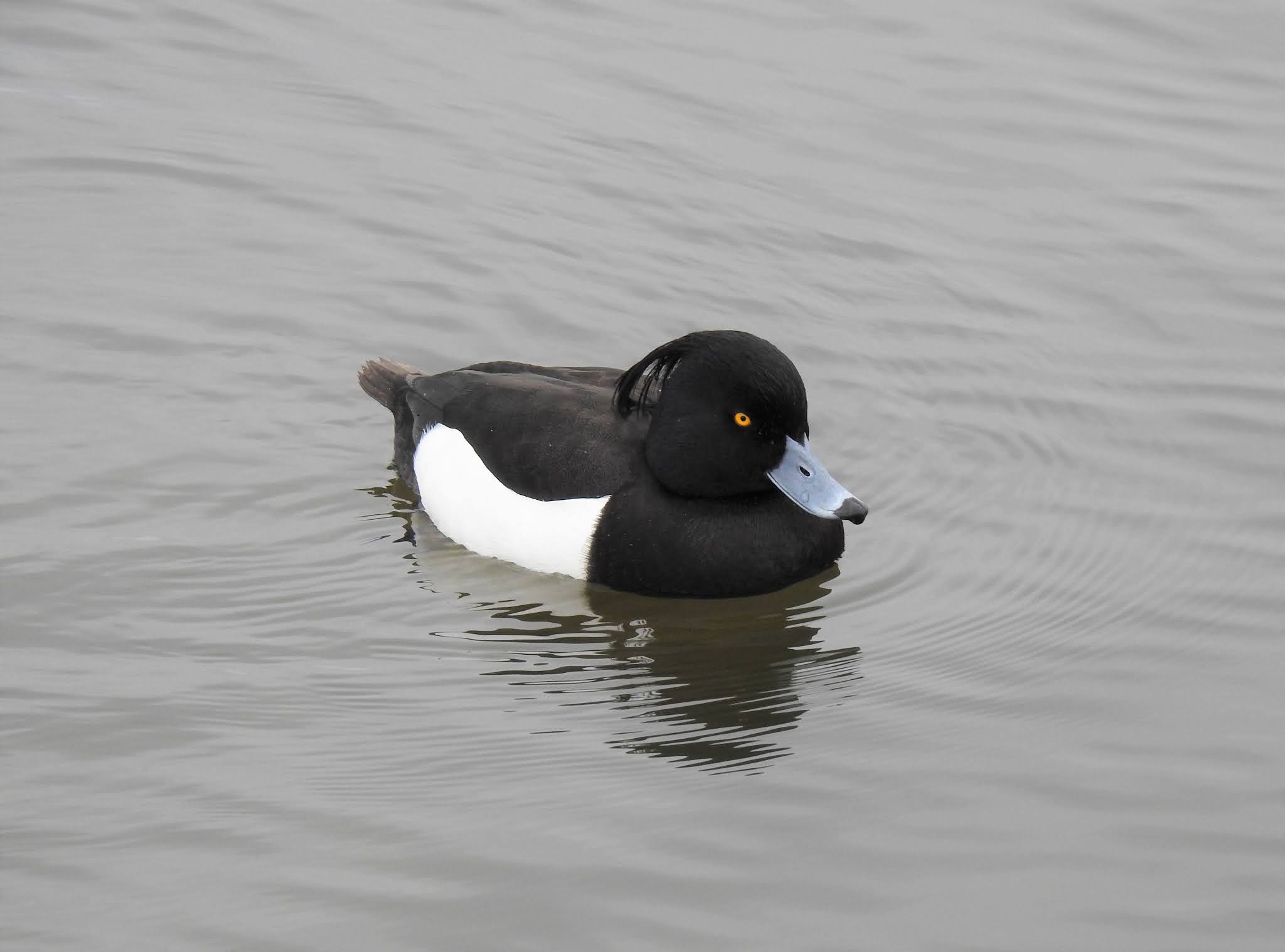
Tufted Duck
 
As I hinted at before, there was a bit of vis this morning, and I stood for a while in the shelter of one of the stone walls and recorded (all north) a Sand Martin, 110 Meadow Pipits, four Woodpigeons, eleven Linnets and two Siskins. 
 
I detected a few grounded migrants this morning in the form of two male Wheatears, two Willow Warblers, a Chiffchaff and a male Blackcap. The male Blackcap flitted through some Bramble that I was stood close to, counting the vis. 
 
Wheatear
 
Driving off the site a female Sparrowhawk flew across the road, and I headed to the cemetery for a quick look. As expected, it was quiet. The vis had slowed down, and the only grounded migrants were two Coal Tits. I could see and hear them calling excitedly from the top of a pine tree, and they suddenly launched themselves into the air, and started flying round in circles gaining height. I was waiting for them to head off north or east, when they changed their minds and dropped back down to the trees! Perhaps they weren't ready to go just yet.  
 
One of the two Robins singing in the cemetery this morning
 
As I said before, it's remaining northerly for a few days yet, but I'll keep plugging away because it's spring, and unlike autumn, migrants still come through even when the conditions aren't perfect.

Wednesday, 31 March 2021

A Bit Of A Push

It was a bit of a push getting up at 3:30 yesterday morning, and this morning at 5:00 a.m., although compared to yesterday, today I had a bit of a lie in! The bit of a push in my blog title refers to the push of spring migrants that was evident the day before. It wasn't a big push, as it can't be at this time of year, but a push it was nevertheless. 

I was in Northeast Lincolnshire yesterday morning on the Humber Estuary again, and it was a lovely clear morning with a light south-westerly wind. The southerly wind was warm, and responsible for a movement of birds. A phone call from Ian as I was getting out of my car, and the first singing Chiffies of the morning were registering, told me that he had just had a stonking male Ring Ouzel on the golf course back at the Obs in Lancs. I must admit, Ring Ouzel was on my radar this morning, but it wasn't to be. 

As I headed off through the scrub towards my VP, I recorded a total of three singing Chiffchaffs. New in at the site was a singing Cetti's Warbler, and it was very vocal with its explosive song. Whether it was a migrant, or a returning breeder I'm not sure, but I'll find in a few weeks when I complete the first Breeding Bird Survey (BBS). 

Other summer migrants were in the form of two Swallows that headed northwest, following the edge of the estuary, and a female Wheatear perched up on the sea wall. Wheatears certainly do like sea walls. 

It was definitely a vis type morning, in fact more of a vis than a grounded morning, and I'll cut straight to the chase with my totals as follows (all between northwest and northeast); 490 Pink-footed Geese, 35 Woodpigeons, three Jackdaws, three Carrion Crows, the aforementioned two Swallows, 28 Meadow Pipits, a Chaffinch, four Goldfinches, three Siskins, 26 Linnets and a Lesser Redpoll. 

As I mentioned before, there is plenty of scrub on site, some wet, some dry, some open, and as a result it provides good nesting habitat for a number of species, like the five Skylarks, a further 13 Linnets, a pair of Yellowhammers and ten Reed Buntings that I recorded. 

Raptors were represented by a male Sparrowhawk and a female Kestrel, and it was the first time out of six, that I didn't see or hear a Buzzard. 

Six Roe Deer were present, and I think I have recorded them on every visit. I suspect that as there is no access to the site, they are a little more confiding than they usually are. A Fox was a first for me for the site, and the vixen sat soaking up some warming rays from the early morning sun. As soon as I moved though, she was off. 
 
Roe Deer
 
Fox
 

I don't see a huge number of Brimstone butterflies in my travels, so it was a pleasure to see a male moving along the sunny south side of a hedge. Unfortunately, it was a little too quick for my limited photographic skills!

This morning, as I mentioned before, it was another earlyish start, but not terribly early, and I headed to my ringing site in the Hodder Valley in Bowland, and put a couple of nets up in the arboretum. It was a bit of an experiment to see whether I could catch in this area, which species, and whether it was worthwhile. 

On my first round I caught a male Blackcap with a fat score of 40, which means it was carrying quite a bit of fat and had a way to go yet on his migratory journey, a Chiffchaff and two Goldcrests. Not a bad first round I thought, but that was it other than a Song Thrush recapture. So, it was a success and a bit of a failure at the same time I suppose, but I was probably there on the wrong day, as there had been a bit of a push the day before, and the wind was northerly. A quick call to Ian on the coast confirmed that it was quiet there too, so I'll head back in the next day or three. 
 
Blackcap
 
Chiffchaff
 

In addition to the ringing, I did have a few bits of pieces in the form of two singing Song Thrushes, two singing Chiffies, a singing Goldcrest, a singing Mistle Thrush, a Siskin over, two Jays, a drumming Great Spotted Woodpecker, a Buzzard, two Coal Tits, two Lesser Redpolls and a female Sparrowhawk.

No early start for me in the morning, as it's a beer night tonight!

Friday, 26 March 2021

The Working Week That Was

My excursions into the great outdoors this past week have been all work related, so let's hope that over the weekend, the weather allows to me get out just for pleasure, not that I don't enjoy it when I'm out and it's work related!
 
It was a week of penultimate wintering bird survey visits, and on Tuesday I was at my site close to the coast. It was a grey old morning, with a stiff south-westerly breeze. A Chiffchaff singing as I got out of the car was nice, and so far, Chiffie is the only true summer migrant that I have had. Greenfinches were very active with lots of calling, song-flighting and general spring-like behaviour, and I do believe that they have made a bit of a recovery from their worrying population crash of recent years. 
 
Next to my VP, I could see a female Chaffinch moving around fairly low down in a Willow sp., and as I watched I could see that she was delicately collecting bits of lichen. Chaffinches use lichen in the construction of their nest to make it more camouflaged, and it certainly works. 
 
I could hear a Great Spotted Woodpecker drumming from an area of mature scrub, and then two birds flew past me in the open, chasing each other, and calling like mad; superb!  

Mid-week I was at my inland site with some freshwater marsh, and it was a brighter day, with 5 oktas cloud cover and a 10 mph west-southwesterly wind. I was there at first light, and when that sun got up, I could feel the increased warmth from its rays. 

Reed Buntings were singing out on the marsh, and I had at least three different birds singing. Moorhens called from within the dense, luxuriant vegetation, and notable in their absence, were the calls of Water Rails. This was my first visit, I think, with no calling Water Rails. However, this is to be expected as they are probably winging their way now to breeding areas anywhere from the UK to northern and central Europe. 
 
Reed Bunting
 
I detected a trickle, and it was a trickle, of visible migration this morning, but the first birds certainly weren't trickling, when thirteen calling Whooper Swans powered their way north. The 'trickle' referred to a single Meadow Pipit north, two Chaffinches, an Alba Wag, a Grey Wagtail and six Woodpigeons. 
 
Whooper Swans
 
The two Coots were still on the marsh, so I imagine they will be nesting shortly, and a Little Egret fed on one of the open pools. A first for me on the marsh was a Cormorant that dropped in to the largest bit of open water, but I wouldn't exactly describe it as Cormorant habitat! The only raptor I had was a calling Buzzard that flew backwards and forwards over the stubbles in the sunshine, flushing the 36 Goldfinches that were foraging there.

It was late morning when I finished my survey, and I headed to my feeding station in the Hodder Valley in Bowland to take down the feeders. The smaller sunflower heart feeders were empty, as expected, and there was just a small amount of feeder seed in my two monster Perdix farmland bird feeders.

After I had packed up the feeding station, I cut a few net rides in the arboretum area of the site, that my predecessor of the conservation charity that I used to work for had designed. Some areas haven't taken as well as others, and these have remained fairly open, and might be suitable habitat for some warbler species. I have had nest boxes up in the valley at this site for Pied Flycatchers since 2002, but I haven't tried the arboretum area for ringing. So, as I can't get into the reedbed and scrub at the pools at the Obs, I intend to have a few ringing sessions here throughout April and May. It will be interesting to see how I get on, and I will of course keep you posted. 

One of the new net rides in the arboretum area

Monday, 22 March 2021

Another Quiet One

I had my final ringing session of the season at my Hodder Valley feeding station at weekend. It wasn't definitely going to be the last, but I had a good idea it would be. Conditions were perfect for ringing with full cloud cover and it was calm, but it would seem that the birds didn't know this!

I ringed just seven birds as follows (recaptures in brackets):

Goldfinch - 2
Coal Tit - 1
Chaffinch - 4
Great Tit - (2)

As usual between net rounds I was serenaded by Song Thrush, Mistle Thrush, Chaffinch, Robin, Great Tit, Goldcrest, Chiffchaff and Siskin. I'm not sure that Siskins do any serenading, as they have quite a harsh and metallic song, but it was good to hear nevertheless. The singing Chiffchaff was my first summer migrant of the year. 

I've had a couple more moth trapping sessions in my garden and over the past two days I caught just a Hebrew Character yesterday, and a Hebrew Character and Early Grey today.
 
Early Grey
 
This morning I headed to the pools at the Obs to see if it would be possible to get a couple of nets up in the 'drier' area of scrub. There was an awful lot of water in the pool, and I could see that it would be a few weeks before we could get to our main ringing area. However, from the car park the drier area of scrub looked like it could be accessible. I walked round to where you can look down on this area, and it was, err..., very wet! So that was that plan scuppered!
 
Later in the week I am going to pack my feeding station up in the Hodder Valley and select a couple of net rides in some open scrub/young woodland that I can use until I can get into the pools at the Obs. The area I have in my mind looks good for warblers, and perhaps calling down a few Lesser Redpolls, Siskins etc. I have also seen a Bullfinch or two in this area over the winter, so I am looking forward to giving it a go.
 
Back to this morning, and whilst I was checking on the very wet, drier area of scrub, I spent half an hour wandering round doing a bit of birding. There are three pools at the site, and over all three I counted 46 Herring Gulls, 13 Lesser Black-backed Gulls, three Little Grebes (there were more), four Mute Swans, 15 Coots, two Great Crested Grebes, two Canada Geese, nine Mallards, 22 Tufted Ducks, a male Shoveler and two Greylag Geese.
 
Tufted Duck
 
A couple of Cetti's Warblers were singing, as was a Song Thrush, a Skylark and three Reed Buntings. A female Sparrowhawk caused a bit of chaos as she flew over the scrape, and that was that. 
 
On my way home I had a quick look in the cemetery to see if there were any grounded migrants, and there was just two Goldcrests.
 
I have got a penultimate visit to one of my wintering bird survey sites tomorrow, and the wind is going to be southerly, so perhaps there might be a migrant or two.

Friday, 19 March 2021

First Moth Of The Year

It was my second trapping session of the year with my garden light trap, and I caught my first moth of the year this morning in the form of the humble, although in my opinion beautiful, Hebrew Character. 
 
Hebrew Character
 
I should have been checking a site for Meadow Pipits this morning, but my car was in for a service and MOT yesterday, and their emissions testing machine broke down, so they asked if they could keep my car until today. Why I am I telling you this? Because I was grounded, 'sods law' came into play, as it often does in these circumstances, and when I was in my garden checking my light trap Meadow Pipits were going over constantly in two to threes. Add in a few Siskins, Chaffinches, Linnets and Greenfinches, and a good bit of visible migration was going on. Even by late morning when Gail and I were out for a walk, the odd Mipit was still winging its way north. 

I would like to have run my light trap again tonight, but I have a 5:00 am alarm call for a ringing session, followed by a four hour shift as a volunteer Covid Marshall at a Covid vaccination centre. 

Fingers crossed for a few birds in the morning, but I have a feeling that it will be time to pack the feeding station up. We'll see.

Thursday, 18 March 2021

Was It The Fog?

Or was it the time of year, the fact that the feeders needed filling up, or all three, that caused me to have a weary ringing session yesterday morning at my Hodder Valley feeding station. When I arrived at 0700, I had 7 oktas cloud cover with a light westerly breeze, but it looked like it was going to brighten up, as the sun was trying to break through. However, within half an hour the fog rolled in, and it remained like that for the next couple of hours. 

I ringed ten birds as follows (recaptures in brackets):

Chaffinch - 4 (1)
Siskin - 1
Coal Tit - 2 (1)
Blue Tit - 1 (1)
Greenfinch - 2
Great Tit - (2)
 
Siskin
 
Coal Tit
 

In all honesty, I think it was a combination of factors that caused such a poor ringing session. At this time of year birds are visiting feeding stations less frequently, as they move away to nesting sites. 

There's a definite dawn chorus now, and songsters this morning included two Song Thrushes, two Chaffinches, Mistle Thrush, four Robins, Goldcrest, Wren, Great Tit and Woodpigeon. There was a bit of a territorial dispute going on with the Mistle Thrushes, as at one point three birds shot past me calling away. In addition to the Siskin ringed, there were at least five other birds around.  

Chaffinch

Two Great Spotted Woodpeckers were present, and a female Bullfinch was a nice addition to my notebook. From outside the woodland, the sound of displaying Curlews and Lapwings was being carried through the dense air, and that further raised the joys of spring! 

I ran my garden moth trap last night for the first time this year, but I didn't catch anything. But it looks like we are in for a dry, but perhaps cold, spell over the next few nights, so I'll try again. 

I'm checking out a drier area of one of the wetland sites at the Obs tomorrow morning, to see if there is anywhere suitable for pulling in Meadow Pipits for ringing, and I plan to give it one more go at my feeding station Saturday or Sunday morning. I'll let you know how I get on.

Thursday, 11 March 2021

All Quiet On The Eastern Front

On Tuesday this week I was back over on the Humber, and it was all quiet on the eastern front. I had full cloud cover with a light westerly wind, and I must admit I did expect a Chiffie, Sand Martin or Wheatear or two, but it wasn't to be.

There was a little bit of vis, and I mean a little bit, with just 17 Linnets, 36 Starlings, a Meadow Pipit, two Chaffinches, a Lesser Redpoll, 10 Woodpigeons and a Goldfinch heading in a more or less north-westerly direction. The only grounded migrant as such was a single Redwing. 

As usual I recorded some wildfowl, with six Teal in the ditches and 158 Shelducks out on the shore. The only raptors I had were a Buzzard and a male Kestrel, and a single Little Egret put in an appearance. Wader numbers had certainly dropped on my stretch of the estuary, although I could see thousands of waders further downstream, and all I had were six Oystercatchers and 52 Curlews.
 
Buzzard
 
Little Egret (above & below)


A few species were in song including Skylark, Wren, Song Thrush, Chaffinch and Reed Bunting. And those were the highlights of a quiet few hours!