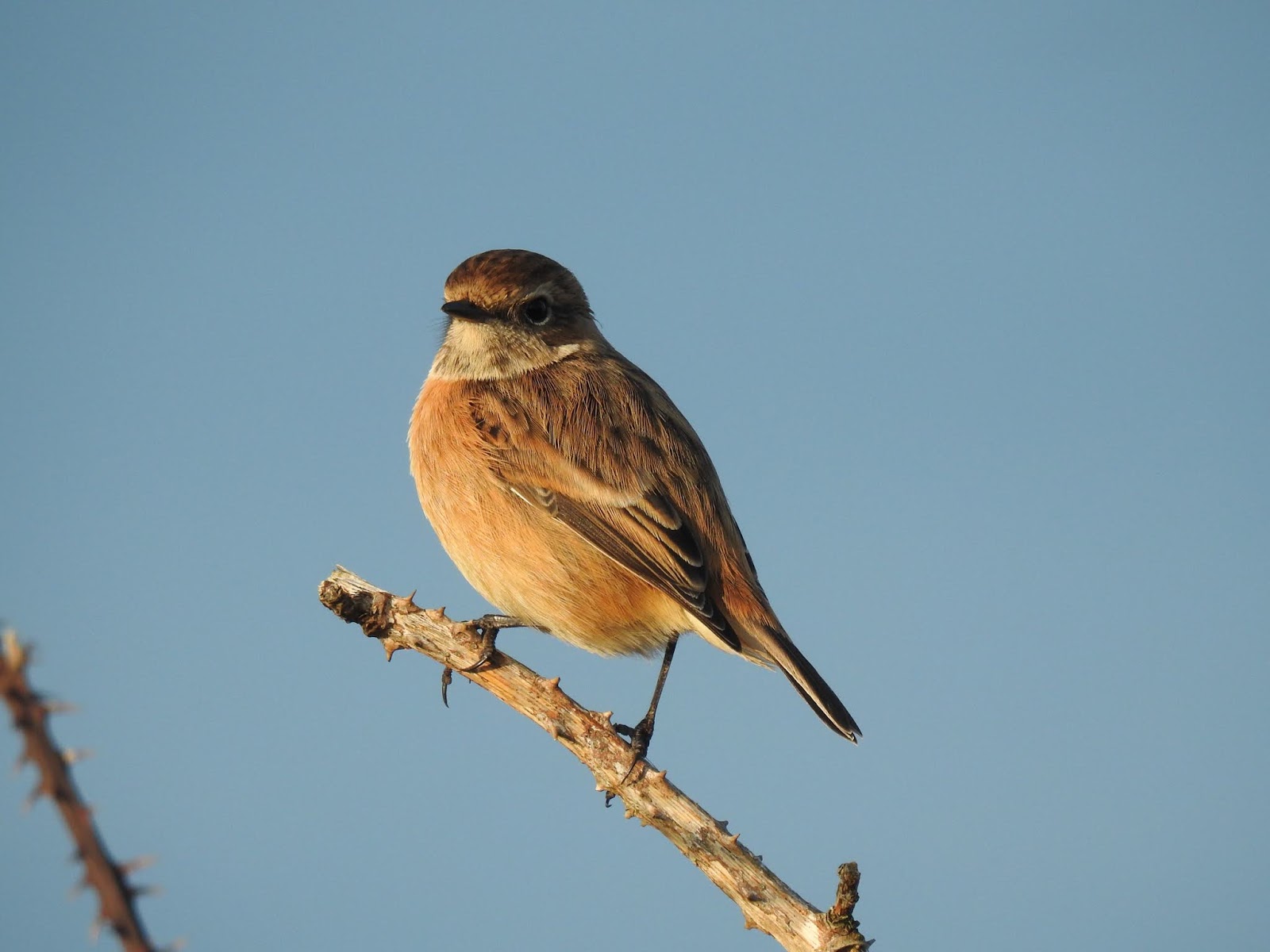
Saturday, 19 January 2019

The Times They Are A Changin'

Over the past ten days I have been surveying at five different sites the length and breadth of the northwest of England. Nearly ten days ago I was at my coastal survey site in northwest Cumbria and it was a glorious day, a tad misty, but the Isle Of man, Ireland and Scotland were all visible. I can rate the visibility at this site by the number of countries I can see!

The most interesting element of the morning was the southerly passage of Cormorants. I have noted a good passage of Cormorants here before and their direction of flight seems to be dependant on the state of the tide; high or low water. This morning they were heading south in groups numbering from 1-2 to 3-400, and anywhere in between. A quick tally from my notebook shows 1,003 flew past my watch point!

 Eleven of the 1,003 Cormorants with Scotland visible in the background.

I did have reasonable numbers of their smaller cousin the Shag, and 19 is as good a count of Shags that I have ever had in northwest England. I had very little else at sea other than nine Fulmars at their cliff nest sites. Not even a Common Scoter, Auk sp. or Red-throated Diver; very strange! It will be interesting to see what I get when I am back there next week after these cold northerlies.

I had very little on land as well, other than a Song Thrush, a pair of Stonechats, two Rock Pipits, a Kestrel, 17 Meadow Pipits and four Grey Partridges, which are always a pleasure to see these days. Grey Partridges are very scarce now and this is the first species that reflects my blog title of 'The Times they Are A Changin'.

I had one or two fly-bys/fly-overs including a female Peregrine heading south carrying prey, and two Ravens north calling.

Eight days ago I was at a site in north Lancashire surveying some intensive farmland under full cloud cover with a 10 mph northwesterly wind. The most interesting observation was twelve Siskins. they were perched in some trees bordering a housing estate, and I got the impression that they were probably birds visiting local garden feeders. It won't be long before these and other finches are on the move. A male Blackcap, two Song Thrushes and three Great Spotted Woodpeckers also made it into my notebook.

A couple of days ago I was out on the mossland in southwest Lancashire and it was a glorious but bitterly cold day; clear skies and a brisk NNW wind. As I was walking along taking photographs of various habitat features I looked up and flying west in front of me was a Great White Egret. I tried to take a few pictures, but as you will see from my results below they weren't much cop! Great White Egrets, Cattle Egrets and more particularly Little Egrets are getting fairly common now, and Little Egret very common. Once upon a time when I was a youngster they were top drawer rarities; a second instance of 'The Times They Are A Changin'!

 Great White Egret - honest!

A few raptors were around as I walked the moss including a female Sparrowhawk, male Kestrel and four Buzzards. Best of all though was a female/immature Marsh Harrier that made a half-hearted attempt to catch some Partridge sp. that it flushed. Again, it wasn't that long ago that up here that Marsh Harriers were very much summer migrants and almost always found in wetlands away from migration. You would not have expected to see one in January hunting over farmland. Another one of those 'The Times They....' moments!

Yesterday I was in deepest, darkest Cheshire at one of my wintering bird survey sites and it was another cold one; ground frost, full cloud cover and a biting ESE wind. Not a drop of sun to raise the temperatures!

Today you almost expect to see Ravens every time you go out birding, and this morning was no exception with two birds calling overhead. The cold weather had also brought a Woodcock in that I flushed from maize stubble close to a mature hedge. The 'wanderers from the north' were still present in the form  of 112 Fieldfares and five Redwings. It's very likely that most, if not all, the three hundred Starlings associating with the Fieldfares were 'wanderers from the north' too!

It's more survey next week, and maybe one day soon I can get back on the patch!

Tuesday, 8 January 2019

Wanderers From The North

You may remember me telling you about Gail hurting her hand whilst we were out birding on Christmas Eve, well she has actually broken it! When she went back to work after New Year her colleagues persuaded her to get it checked out, and an X-ray later it's confirmed that it is broken! Her hand and arm are now in plaster, and it has certainly put the brakes on my birding, hence the lack of updates. I'm not complaining because when you're married that's what you sign up for, I'm just telling you this to explain my 'radio silence'.

I've had to keep my paid bird surveys going as that's what keeps the 'wolf from the door' and last week I found myself at my survey sites in Cheshire and northwest Cumbria. First up was Cumbria and on the morning of my survey it was cold, frosty in fact, with clear skies and a light ENE wind. Visibility wasn't bad, the Isle of Man and Scotland, but no Ireland!

As usual I spent some time recording activity at sea and it wasn't exactly rocking, just 108 Common Scoters, 240 Cormorants, two Shags and two Red-throated Divers.

I had a female Sparrowhawk head south over the sea, and I think she was the culprit that flushed all the Skylarks because shortly before I picked her up I had 79 Skylarks in the air! The only other passerines of note were a single Rock Pipit, Stonechat and Reed Bunting.

During my sea-watch I heard the familiar call of Pink-footed Geese behind me and I looked up to see 24 heading northwest very high. They kept on motoring across the sea until they were lost from view. Looking at their flight direction and extrapolating this, assuming they carried on in the same direction, they would have made landfall somewhere in the region of the River Dee estuary in Dumfries and Galloway!

Later in the week I was at my 'landlocked' Cheshire site, and again it was very cold with 6 oktas cloud cover, and to be honest I didn't expect very much but I did have a couple of nice surprises. Well, nice in terms of good birds for the site!

The Meadow Pipits were still around in the wet maize stubble, and I had a flock of 38, but it was the 'wanderers from the north' that was one of the nice surprises. At this time of year you often find Fieldfares foraging in improved pastures mixed up with Starlings, and on this particular morning I had a nice flock of 106.

 I didn't manage to photograph any of the Fieldfares, so here's one in the hand
from a few years ago.

Four Buzzards wasn't really a surprise, but a female Yellowhammer perched on some telegraph wires was. The second of the nice surprises. A couple of Song Thrushes and a Raven later and it was time to head off home.

It's surveys for the remainder of the week for me, so I am hoping for a few more wanderers from the north.

Saturday, 29 December 2018

Early Songsters

As soon as I get to the Solstice I get excited as it is the start of the new year, and the 25th has a special significance as it is the first day when you can actually detect lengthening day light, as there is a minute more of the stufft! Not much I know, but at least it is heading in the right direction.

It even seems to me that our avian songsters detect this lengthening in the day and more and more species start to sing. Whilst out and about this past week I've had, in no particular order, singing Song Thrush, Great Tit, Wren, Robin (Robins do sing throughout the winter though), Dunnock and drumming Great Spotted Woodpecker. It certainly lifts the heart, even though I know we have a couple of tough winter months ahead of us.

Just before Christmas, on Christmas Eve in fact, Gail and I had a walk down to the estuary and it didn't turn out to be the successful birding walk we planned, as Gail took a tumble crossing a particular muddy bit near the saltmarsh and hurt her hand. Nothing broken, just a bad sprain, but she wasn't overly enthusiastic about the rest of our walk, not just because of being in some pain, but she was covered from head to foot in mud!

 The view across to the Lakes at the mouth of the estuary (above) and 
Bowland to the east (below)


Before her tumble we had quite a few Blackbirds, fifteen to be exact, walking through the Hawthorns. Winter Thrushes have been scarce of late, so it was nice to record so many Blackbirds. As we approached the saltmarsh a Water Rail called from the reedbed and 129 Pink-footed Geese came from the coast and headed inland over the river. It was just about at this point when Gail went bog snorkling!

 High flying 'Pinkies'

Bravely she soldiered on, but she wasn't enjoying scanning and counting the wildfowl on the river, so three hundred each of Wigeon and Teal had to do, but there was a lot more. I managed to enter 80 Redshanks and 200 Lapwings in my notebook, before I decided Gail had suffered enough and we headed home. A quick detour past a regular Waxwing spot in recent winters revealed zero Waxwings, but I will be keeping an eye out over the rest of the winter.

It's funny that I mention a lack of Winter Thrushes as a few days later whilst surveying in Cheshire I did have a few Fieldfares and Redwings, but only 17 and 10 of each respectively. Three Buzzards made there presence felt calling away, as did a couple of noisy Jays. Jays always seem excitable, and give the impression that they are permanently cross about something. I've ringed a few Jays in my time and in the hand they are just as excitable!

 Jay

I know I've said before, but the habitat at this particular survey site is intensive farmland consisting of maize stubbles, rye grass desert and hedges flailed within an inch of their life, so it was nice to record 48 Meadow Pipits in a wet bit of maize stubble, and Grey Wagtail and Raven are always a bonus.

The weather is looking settled for a few more days, so I'll try my best to get out in the morning and northwest Cumbria beckons for some survey work on New Year's Eve.

Saturday, 22 December 2018

Here's A Blog Post For Ya!

Yesterday on the Solstice I had a bird survey to do fairly close to home. I was a little concerned about the weather as it forecast light rain throughout the morning, but I took the chance that it would be light enough for me to complete my survey without any issues. Sure enough at first light, not very early at this time of the year, I had full cloud cover, the forecast light rain and a light easterly breeze.

To the north of my vantage point I could see flock after flock, though not large flocks, of Pink-footed Geese heading east from their overnight roost on the river. In total I had 972 head east with some of them treating me to an overhead flypast. I can't think of a more evocative call than that of the 'Pinkie' and other wild geese, as their call immediately brings to mind the wild places that they inhabit.

Pink-footed Geese

I've had some decent counts of Lapwings from this site, although the Lapwings haven't been using the site, when local birds have been flushed from their feeding areas. A couple of flocks have numbered over a thousand birds, but today it was a mere three hundred. 

 A handful of Lapwings 

One of the seasonal cards we received from a good friend in York had a picture of Long-tailed Tits on the front as it is her favourite bird, and I must admit I never tire of watching them. A favourite nature writer of mine, Jim Crumley, in his book 'A High and Lonely Place' said about Long-tailed Tits..."the place bristled with Robin song, although it was only January, and flocks of Long-tailed Tits rolled through the twiggy crowns of fieldside trees like squeaky airborne puffballs. There is no aerobatic feat beyond them, no pose too precarious, no impossible demands of landing and take-off". Marvellous! Oh, and I had nine of these squeaky airborne puffballs this morning!

 A squeaky airborne puffball!

Round here winter Thrushes are a bit thin on the ground at the moment, so it was nice to record a Redwing, and as always it was a delight to encounter three Song Thrushes. Anecdotally, and without looking up figures from the BTO, I think Song Thrushes are having a slow up-turn in fortune. The same can't be said for their larger cousin the Mistle Thrush, of which I only had one this morning, that has disappeared from a number of sites I used to regularly record them at. 

Other bits and pieces that I had were 24 Chaffinches, a Greenfinch, a Reed Bunting, a Grey Wagtail, 43 Goldfinches, a Jay and thirteen Meadow Pipits

It's going to be very wet tomorrow morning, so it will be next week before I am out again. High pressure is nudging in on the 24th and it looks set fair for the week. At last!

Friday, 21 December 2018

Solstice Greetings

Wow, I can't quite believe it has been two weeks since I posted anything! No excuses, I've just been busy, busy, busy! The weather is bucking up next week, and as such the only day I won't be working is the 25th. When the sun shines the bird surveyor has work to do!

I just wanted to take this opportunity to send you Solstice Greetings, and however you celebrate the mid-Winter, I hope you enjoy the festivities!

Woodland is a brilliant place to visit on the Solstice, to think about the old
year and contemplate the new.

Friday, 7 December 2018

It's becoming a habit...

...this only getting out birding a couple of times per week! The weather has been so appalling of late that I haven't bothered going out. I could go through the motions and go out for the sake of it, but luckily I can get my birding 'fix' through work!

In fact sometimes you have to complete surveys in weather that you wouldn't go out birding in for pleasure, and a week ago this was the case. I have a survey site close to home and there are a mix of habitats including grassland, broad-leaved woodland, hedgerows and water courses.

My notes state that on the day I had four oktas cloud cover with a 5-6 SW wind and frequent heavy showers; eek! Luckily on site there was somewhere I could shelter to carry out my Vantage Point (VP) observations. Surprisingly I did have a few bits and pieces despite the weather and they included a male Sparrowhawk, two Little Egrets, two Grey Wagtails, 59 Goldfinches, two Redwings, two Coal Tits, seven Long-tailed Tits, two Great Spotted Woodpeckers, three Song Thrushes, 900 Lapwings, a Buzzard and 24 Chaffinches. Not bad considering the weather!

I was back at the site earlier this week on a clear, calm frosty morning and to be honest with you I didn't have as many birds! My totals included four Song Thrushes, 324 Pink-footed Geese, three Stock Doves, two Mistle Thrushes, a Little Egret, a Brambling, 37 Rooks, 1100 Lapwings, a Grey Wagtail, two Skylarks, 19 Goldfinches and two noisy Jays.

The photo below is of the sunrise at the site on that frosty morning. The weather is looking a bit grim for this weekend, although Sunday is a possibility!


Saturday, 24 November 2018

Groundhog Week

I do apologise dear readers as there will be a sense of deja vu regarding this post! I've only been out twice since my last post and it was to the same two sites again; deepest darkest Cheshire and glorious northwest Cumbria.

It dawned clear and frosty in Cheshire with a light easterly wind. I had an experience that I have never had before when out birding and that was moisture forming in my beard because of the cold conditions (I've experienced that bit before), and then it was dripping onto the eye-pieces of my bins! Very annoying!

There wasn't much to report really other than seven Fieldfares, a Jay, four Buzzards, a Brambling, two Stock Doves, six Linnets, ten Skylarks, four Redwings and seven Lapwings. I was surprised I had that much in the ryegrass desert, with butchered hedgerows, habitat that I was in!

Fast forward to glorious Cumbria and it was a morning where Stonechats would feature strongly. It was another beautiful morning and walking down towards my cliff-top vantage point I came across a male and two female Stonechats. The male showed really well in the November sunshine and proceeded to have a good old preen in front of me, and I took the following snaps.


Interestingly, on my way home I stopped in a parking area to have my lunch, in view of the coast, and there in front of me working their way along a wire fence fly-catching was a pair of Stonechats, and the female is pictured below. Is this part of Cumbria the Stonechat capital of the UK?


Going back to my survey there are two elements to it, a land-based bit and a coastal bit. The land based bit didn't turn up much other than three Siskins, 17 Meadow Pipits, the aforementioned Stonechats and a Buzzard.

Looking from my coastal watch point I had a male Peregrine fly south and I wish I had it seen it coming sooner as it looked fantastic in the crisp light. Where was my camera I hear you ask, and the answer was in it's case on the floor next to my rucksack! 

I'd not long sent a text to Gail saying "no Harbour Porpoise so far, or indeed any other marine mammals", when two Harbour Porpoises appeared slowly moving and feeding offshore! I got cracking scope views with my new x 25-60 wide angle zoom lens, as they did their rolling breach in full glorious sunshine! Maybe I should have sent Gail a text saying "no Orca's so far"!

I'm used to seawatching off the Fylde coast of Lancashire where any views of Common Scoters are miles away, even though they might be in good numbers. So it was refreshing being at a site where I could look down on them relatively close and watch them diving and feeding! The best of the rest from the coast was two Shags, two Red-throated Divers, a Guillemot and three Auk sp. 

Driving back home I noticed that the first snow of the winter was on the tops of some of the lakeland fells such as Skiddaw, and very seasonal it looked too!