Saturday, 29 November 2014

From Tree Sparrows to Twite

I had some reasonable counts yesterday at my feeding station with definitely the highest count of Tree Sparrows of the winter so far with 136, and Yellowhammers a respectable seven. I had my best Corn Bunting count of the winter so far with 28 and Great Spotted Woodpecker and Grey Wagtail made up the best of the rest. On my way home I had a look on the flood and the two Green Sandpipers remained with 15 Redshanks.

I didn't have a huge amount of time this morning for birding as I had to try and get a new car sorted out for Gail (not brand new, just new to Gail!) so I just had an hour and a quarter on the estuary. Potentially based on last night's forecast I could have gone ringing this morning but I was glad that I hadn't as the wind was a stiff easterly and too strong for mist nets; I've saved that for tomorrow.

 Sunrise on the estuary

I think the theme of this morning was really looking at birds, because I think as birders we are guilty of counting birds without really 'looking' at them, or I am sometimes anyway. I heard Redshanks alarm calling and there 'shooting' just a foot or so above the mud was a male Sparrowhawk. I watched it come across at lightning speed and then it pulled up to fly over the fence, drop back down to ground level, pull up over another fence, drop back down to ground level and then pull up over a house and then I lost it; brilliant!

There were 39 Redshanks out on the mud with fifteen Black-tailed Godwits and a single Knot. The Blackwits were the second species that I really 'looked' at this morning as I was watching them to try and get some pictures. I observed a couple of birds feeding and two bits of, what is probably very common behaviour, struck me. I assume that they were feeding on Ragworms as I could see them puling out pretty lengthy and hefty worms from the mud. One bird every time it caught a Ragworm would run down to the creek, wash it and then swallow it. Presumably it was removing all the sand and grit!


I was also amazed at how far they would push their heads in to the mud to try and find these large juicy worms. Sometimes their heads were completely submerged with mud half way up their necks! As I say, this will be common behaviour, but I hadn't noticed it before because I obviously haven't really 'looked' at Blackwits in any detail in the past.


As the sun rose the Pink-footed Geese were lifting from their estuarine roost and I had 707 take off and head north and east to their feeding sites. Talking of birds exiting roosts I had 20 Twite fly past me, heading to foraging areas on the saltmarsh from wherever their roost site was. After 250 Lapwings and 228 Herring Gulls out on the mudflats it was time for me to turn back and head home.

Thursday, 27 November 2014

Three Figures!

I called at my feeding station this morning and I was going to say that it was the first time this winter that the count of Tree Sparrows had reached three figures, 107 this morning, and then I looked back in my notebook and saw that on 8th November I had 110! So it is only the second time this winter that the count has got into three figures. There's probably a few more to come yet as they usually peak at about three hundred.

The Yellowhammer numbers are impressive here for the time of year and this morning I counted 14. I know these aren't huge numbers, but normally I wouldn't get these sort of numbers until 'the hungry gap' towards the end of winter, so I'm not sure what's going on. Two thoughts occurred to me; either a good breeding season so there are more birds around or a shortage of food locally forcing them to come to the feeding station earlier than normal.

On my way home I called at the flood and there were two Green Sandpipers, eight Redshanks and 50 + each of Meadow Pipit and Pied Wagtail. Oh and a Grey Wag too.

Sunday, 23 November 2014

Birding North Of The Border


From the picture above you can see that I was birding north of the border yesterday in Scotland, and along the Solway coast at Caerlaverock NNR to be precise. I had dropped Gail off at a Christmas cake decorating day in north Cumbria and as I wasn't due to pick her up for a few hours I decided to pop north of the border to do some birding.

The weather was quite kind to me considering what it had been like driving up and I had three oktas cloud cover with a 15 mph southwesterly wind.

I didn't see a huge variety of species but it was just nice to be out birding in a different part of the world and seeing Barnacle Geese, which have got to be one of the best looking geese anywhere. As I stated above I headed to Caerlaverock NNR, not the duck brothel a little further up the estuary, and I had a walk along the board walk through the reedbed near Holland's Farm and had a look across the saltmarshes and out on to the estuary.

 Barnacle Geese

I didn't have a huge variety of species, but what the day lacked in variety it made up in terms of numbers. Barnacle Geese were certainly the feature of the day and in total I had 1,180; some in roadside fields driving to the site and the majority out on the saltmarsh as the tide ran in.

I didn't have much in the reedbed other than a calling Water Rail, thirteen Skylarks over and four Reed Buntings. I had a look from the hide at the eastern end of the reedbed, but this was pretty useless and the picture below shows why; not the best of views from a hide!

 Not the best views from a hide!

I also met a couple walking their dogs on the boardwalk and they had three dogs; one on a lead and two Spaniels off the lead and they were continually crashing through the reeds. It's a fecking NNR for heaven's sake!

 The board walk

Out on the saltmarsh were a number of waders and wildfowl including 363 Lapwings, 96 Shelducks, 40 Wigeon, 600 Golden Plovers and 75 Curlews. Suddenly everything got up and a female Hen Harrier sailed in to view giving stonking views. Rather than dive for camera I decided just to enjoy the spectacle and watch her float past; brilliant!

 Views across the reserve

I then headed to another site further east on the reserve where there was an impressive number of waders roosting including a thousand Lapwings and 3,700 Oystercatchers. No raptors here but a Raven flew over that stirred things up a bit. Soon enough it was time to pack up and head back south to pick Gail up.

 Gail's decorated Christmas cake

I should have been ringing at my feeding station with Huw this morning but a sleepless night after a bout of bad heartburn meant I had to call it off, but I did get there later in the morning to feed. Tree Sparrows numbered 40, with an increase of Yellowhammers to eight, and a a flock of thirteen 'honking' Whooper Swans over rounded off my quick visit.

Friday, 21 November 2014

Same Old Same Old!

I'm back in that same old winter routine now of birding at weekend and then my feeding station visits takes up any mid-week birding time that I might have. I called yesterday to feed and Tree Sparrows numbered 83 with eleven Chaffinches and singles of Corn Bunting and Yellowhammer.

On the way home I called at the flood and Redshanks had increased to six, but there was only one Green Sandpiper. I should be able to report a few hours of birding north of the border tomorrow, so I'll let you know how that goes.

Monday, 17 November 2014

Great Northern In A Northerly For Breakfast

Straight after breakfast I headed to the shore to spend an hour or so watching the sea over the falling tide before heading back home to write yet more reports. I had full cloud cover this morning with a 20 mph northeasterly wind.

Walking up to my observation point I had few waders on the beach including five Turnstones, 157 Oystercatchers, eight Grey Plovers and 16 Sanderlings. There would have been far more waders roosting on the shingle ridge, but time was of the essence this morning so I just stayed at my observation point. I managed to find some shelter and glued my eye to my scope.

After I had been watching for about twenty minutes I picked up a large Diver heading northeast, slightly away from me and across the bay, and I soon realised that it was a Great Northern Diver! The supporting cast included 18 Eiders, 75 Cormorants, 49 Common Scoters, five Red-breasted Mergansers, three Greylag Geese, a Razorbill, a Great Crested Grebe, a Red-throated Diver and an Atlantic Grey Seal.

Unfortunately it was soon time to head home and do some work. I am hoping to escape for an hour or so in the morning on Wednesday and I'll let you know if I do.

Sunday, 16 November 2014

Weekend Round-Up

Yesterday morning I had a mooch round the Obs and at first light I had full cloud cover with a 10 mph southeasterly wind. There was a little vis (all south unless otherwise stated) and this included a Blackbird, two Fieldfares, four Chaffinches, 80 Woodpigeons northeast, a Reed Bunting, two Skylarks (and then dropped on to beach), seven Greenfinches and two Goldfinches.

 Greenfinch

There seemed to be a few Thrushes grounded in the form of a Mistle Thrush, a Fieldfare and three Song Thrushes. There were a number of Blackbirds around but it wasn't obvious whether they were freshly grounded or not.

Pink-footed Geese were arriving from their roost on the estuary, 1,392 in total, but someone was shooting at them as they were coming in to the farm fields. In fact there was a lot of shooting going on and I could see huge numbers to the east being disturbed through shooting. I'm not anti-shooting per se and if someone shoots a goose to eat rather than buy some factory reared chicken from a supermarket then that's okay by me. However, I'm not in favour of people shooting for a giggle, particularly fantastic migratory species like Pink-footed Geese. And in cases when people are shooting for a giggle I don't understand how they can gain pleasure from killing something for a laugh, and perhaps it says something about their personality!

 Pink-footed Geese arriving to be shot at!

A Little Owl perched at the top of a down spout was a pleasant distraction before I had a look on the sea. The sea was fairly quiet other than 33 Common Scoters, two Great Crested Grebes, eight Cormorants and twelve Shelducks.

 Little Owl (honest!)

I then headed to my feeding station to feed in preparation for this morning's ringing session. A total of 52 Tree Sparrows were present plus two Yellowhammers and a Corn Bunting.

 Tree Sparrow

This morning I met Huw and Aimee at my feeding station just as it was coming light and we put two nets up in cloudy and calm conditions; perfect for ringing. As ever at the feeding station the aim is to try and ring red-listed farmland birds and we didn't fail this morning but the numbers weren't high. We ringed 19 birds (recaptures in brackets) as follows:

Yellowhammer - 2
Greenfinch - 1
Robin - 1
Great Tit - 2
Tree Sparrow - 3
Blue Tit - 10 (5)

 Yellowhammer

Whilst we were putting the nets up in the 'half light' a male Tawny Owl called from the wood and we flushed five Grey Partridges from where we set up our ringing station. Other species recorded whilst birding between net rounds included 14 Fieldfares, a Buzzard, 230 Jackdaws, four Yellowhammers, a Grey Wagtail, eleven Skylarks, a Corn Bunting and a Siskin.

On my way home I called in at the flood and the two Green Sandpipers had been joined by three Redshanks. There's a tide in the morning so I might have an hour at first light before locking myself in my office for the day!   

Thursday, 13 November 2014

One Or Two Bits And Pieces

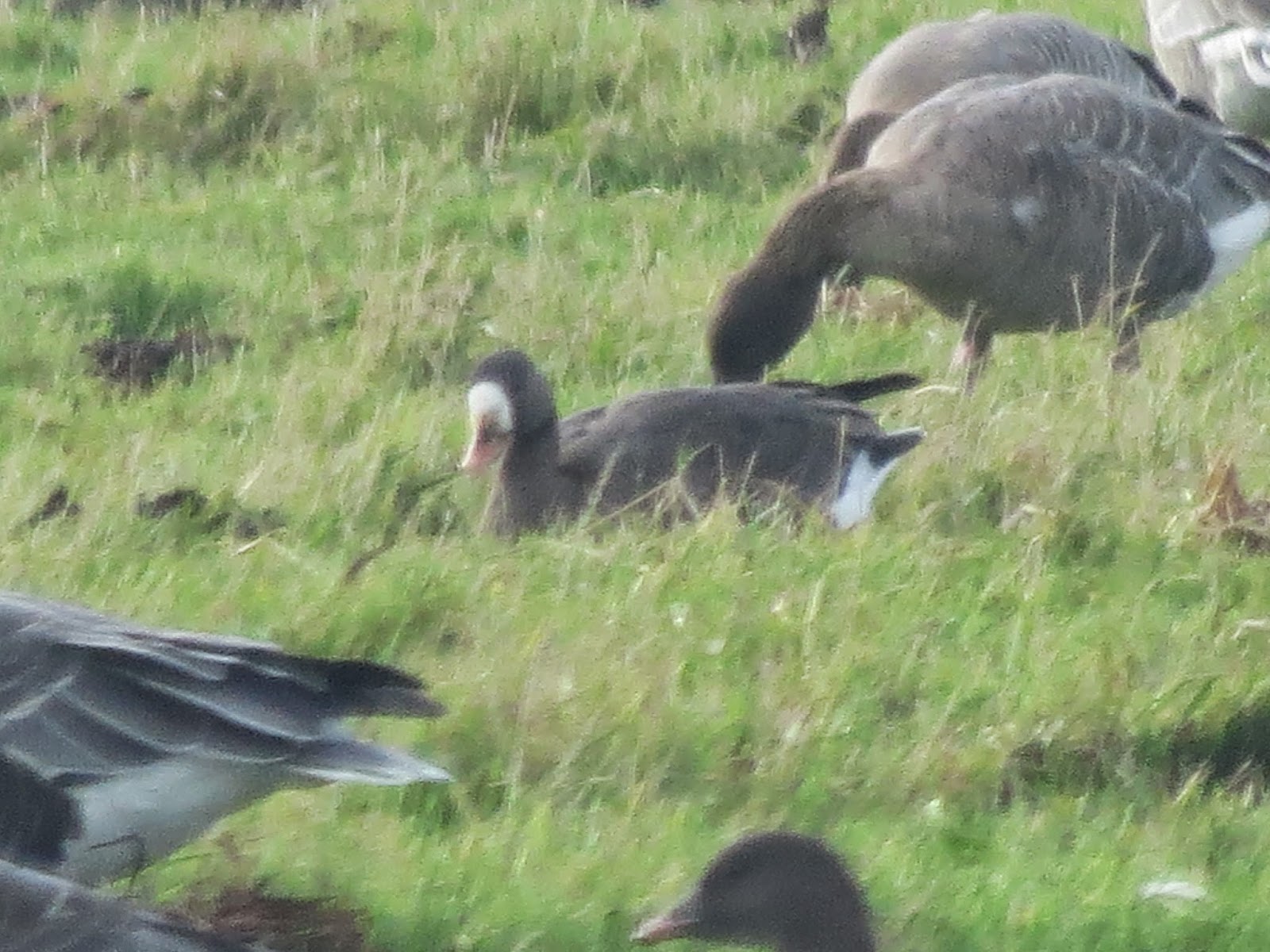
I couldn't describe the week so far as 'full on' from a birding perspective but I have had one or two bits and pieces. I was driving back from site visits on Monday when Ian phoned me to say that there was an adult Greenland White-fronted Goose amongst the Pink-feet. I knew where the Pink-feet were feeding and as I was close to home I decided to go and have a look.

After a few minutes I found the 'White-front' amongst the c. 2,000 Pink-feet. It was feeding at times and then it would lie down and feed whilst down on its belly. I only had bins with me but it was easy to pick out and I couldn't see anything else amongst the Pinkies. I've attached a shot of both the White-front and Pinkies below, but I must point out that the White-front shot was taken through my car windscreen on full zoom.

 Greenland White-fronted Goose

Pink-footed Geese

Yesterday I called at my feeding station and Tree Sparrows numbered 95 with a supporting cast of three Yellowhammers and 14 Chaffinches. On my way home I looked on the flood and there were still two Green Sandpipers with at least 40 Pied Wagtails and a number of Meadow Pipits.

The forecast is looking okay for ringing at weekend, so fingers crossed that it remains so and I can get a first session in at the feeding station.