Thursday, 23 December 2021

No More Feeding Station Blues

At the end of last week, I was at one of my wintering bird survey sites in northwest Lancashire, and it was a quiet one. In fact, when I was at my second VP, I sent a text to Gail saying I'm in danger of falling asleep standing up, it's so quiet! There was more activity at my first VP, and I guess that's because I was at this VP from first light, and at this time of year the flurry of post-roost activity is short-lived. 

It was a cold morning, with full cloud cover and a light south-easterly wind, but that didn't prevent nine Brown Hares from being active. You know what I think about Brown Hares, gorgeous creatures. Pink-footed Geese were very thin on the ground, and the only post-roost movement I had were skeins of 24 and 26. 
 
Just two species of raptor, a Buzzard and a male Kestrel, and a Snipe over was the only wader species of wader that I recorded. There were still quite a few wintering thrushes about, and I had four Song Thrushes, 40 Redwings, nine Blackbirds and 61 Fieldfares. 
 
I did have one good bird, in the form of a female Bullfinch. Bullfinches are quite scarce in this area, so it was good to both see and hear, and it was a first record for me for the site. 
 
Last weekend I managed to banish those feeding station blues, and Alice, John and I managed a ringing session at the feeding station. We went on Saturday, as the forecast for Sunday was for fog, and if it was foggy, we wouldn't have been able to have a look on the wetland. Guess what? Saturday turned out to be foggy, and it was a bit of a 'pea souper', so it was pointless even attempting to have a look on the wetland, as it was a case of "what wetland"? 
 
We managed to ring 36 birds as follows (recaptures in brackets):
 
Blue Tit - 15 (6)
Great Tit - 5
Chaffinch - 5
Robin - 1
Dunnock - 3
Tree Sparrow - 7 
Nuthatch - (1)
Coal Tit - (2)
 
Tree Sparrow
 
It was good to ring the Tree Sparrows, as this was the main reason for setting the feeding station up. It also gives us the opportunity to gather more data on this red-listed species, as there is a healthy breeding population at the farm that we monitor in nest boxes, so to catch them in the winter, it completes the circle. 
 
I'm working tomorrow, but this time I am completing a survey fairly close to home, so at least I should be finished by lunchtime. I am expecting it to be fairly quiet, but that's the beauty of the natural world, you just never know! 

It just remains for me to wish you a merry, whatever it is you celebrate as part of the winter festivities, and here's to a happy, healthy and nature filled new year!

Monday, 20 December 2021

Stormcock Singing In The White Wind

A nature writer, whose work I have only recently started reading, Seton Gordon, is now one of my favourites. I discovered Seton Gordon through Jim Crumley (who is my very favourite nature writer), and in many of Jim's books, he references Seton Gordon, and talks about what an inspiration his writing was to him. Seton Gordon was a Scottish naturalist and writer, who was born in 1886, and died in 1977. He wrote somewhere in the region of thirty books between 1907 and 1971, including such classics as The Charm of the Hills, Wanderings of a Naturalist, Hebridean Memories, Days With the Golden Eagle, The Charm of Skye; The Winged Isle, Islands of the West, Highways and Byways in the West Highlands and Highways and Byways in the Central Highlands to name but a few.
 
I have just finished The Charm of Skye (1929), and in it, Seton Gordon talks about how the old Celtic seers knew each wind by its own mystical colour:
 
From the East blows the Purple Wind,
From the South the White.
From the North the Black,
From the West the Pale.
 
Apparently, these colours were not woven out of human fancies, they had an occult, inner meaning. I thought about it for a bit, and I could relate to these colours. Some were more obvious than others, but I couldn't help agreeing with the old Celtic seers, that these colours did represent each wind. 
 
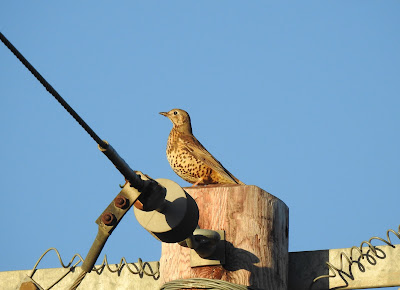
One of my favourite birds (I have a lot of favourite birds) is the Mistle Thrush, in fact I have a soft spot for all the Thrush species, but for some reason the Mistle Thrush, or Stormcock to give it one of its old names, is a favourite in that family of favourites! I think maybe, it is because in the depth of winter you can hear Mistle Thrushes singing, and indeed during the storms of winter it can be heard singing, giving hope that the days will lengthen soon, and spring is just around the corner. Hence, Stormcock! 
 
Stormcock (above & below)


When I looked up the Mistle Thrush in All the Birds of the Air - The Names, Lore and Literature of British Birds by Francesca Greenoak, I could see that it had many old localised names, in fact there aren't many species with more. In case you are interested, I have listed all the old names that are given for the Mistle Thrush in this lovely, and interesting book; Hollin Cock, Holm Thrush, Holm Cock, Holm Screech, Muzzel Thrush, Mizzly Dick, Screech, Skirlock, Skrike, Skrite, Squawking Thrush (a bit harsh I think), Gawthrush, Jay (interesting), Jay Pie, Jercock, Chercock, Stormcock, Jeremy Joy, Big Mavis (I like that one), Big Felt, Bull Thrush, Horse Thrush (they often forage in horse paddocks), Corney Keever, Crakle, Bunting Thrush, Butcher Bird (I thought that was just shrikes), Felfit, Fulfer, Hillan Piet, Fen Thrush, Marble Thrush (apt), Norman Thrush, Stone Thrush and Wood Thrush. That's 34 different names!
 
Its scientific name is Turdus viscivorus, coming from viscum for mistletoe, and voro to devour. So, a thrush that devours mistletoe, and that's what they do! They will have a winter feeding territory that they will defend from all comers. And the mistletoe has the solstice connotation that is so apt for this time of the year.
 
On a cold, frosty morning last week, under beautiful blue skies with a 'white wind', I found myself on a west Lancashire mossland doing a bird survey, where I encountered five of these beautiful birds. I watched one Stormcock singing in the white wind as it alighted on top of a telegraph pole to join two other Stormcocks. When you hear a Stormcock singing in flight, it is magical. They have a very loud, determined, and liquid song, like a slowed down Blackbird on steroids, turned up to number 11!  As they approach with that gently, undulating flight, as if on a children's roller-coaster, the song gets louder, and louder until they are there, in front of you, perched up, ready to face off any bird, probably any one, that dares to get too close to their favourite fruiting tree. Marvellous! 

Close to where the Stormcocks were, in a sheep grazed paddock, was a flock of 26 Redwings and 48 Fieldfares, all feeding on invertebrates in the short sward. Sometimes, one or two of the Stormcocks would fly down and join their Nordic cousins. 
 
Fieldfares, Redwing and Starling
 
I started my survey at first light, and as a result, picked up on some of the Pink-footed Geese flying from their overnight roost to feeding areas, and I had 266 flying in a general north to east direction. The stubble field in front of my VP held 32 Skylarks and eleven Linnets. Three Grey Wagtails were noteworthy, as was a flock of 354 Woodpigeons and 80 Jackdaws. The best of the rest included 14 Goldfinches, a Great Spotted Woodpecker, five Stock Doves and six Reed Buntings. 
 
But nothing could match the Stormcock singing in the white wind.

Sunday, 12 December 2021

Feeding Station Blues

The weather has been trying its hardest to prevent me from getting out in the field of late, and this past week it nearly succeeded, but I did manage to get out and complete a survey on Thursday morning. It had rained for most of the previous few days, so I chose to survey one of my wintering bird survey sites that wouldn't be too treacherous under these conditions. 
 
This particular pastoral farmland site in northwest Lancs does receive a lot of disturbance from people walking their dogs, as it is right next to a small market town. However, the combination of the wet weather creating some floods on some of the fields, and the fact that the farmer is now grazing the fields with some sheep, has reduced the disturbance considerably, and it will be interesting to see what effect this will have on my survey results for the remainder of the winter.  

I set off to walk to my first VP on this Thursday morning under full cloud cover, with a 3 - 4 NW wind. As I said before, the site is next to a small market town, and as a result the hedges closest to the houses were full of 'chirping' House Sparrows. Hard to estimate how many, just a 'HS' with an underscore on the map, to show calling House Sparrow. 

There were a few wintering thrushes, in the form of two Fieldfares, 21 Redwings and a Song Thrush, but once again it was the number of Blackbirds that topped the score sheet, with 24 recorded! Another high scoring species, in terms of numbers, was Magpie, and I had 41 of these black, blue, purple, green and white, iridescent corvids. 

Three Stock Doves, five Long-tailed Tits, a Siskin, 17 Goldfinches, a female Kestrel and a Goldcrest are all worth mentioning, but I didn't have much else. 

Yesterday morning I was back at the feeding station to top up, and have a look at the wetland, and once again it wasn't fir for ringing. The wind strength was okay, a light south-easterly, but it was wet, and it was forecast to be wet on Sunday as well. So, it was another case of feeding station blues. 

Having said that, the feeders were very busy, and it was nice to be topping the monster 20 kg seed feeders up to a backdrop of calling Tree Sparrows!

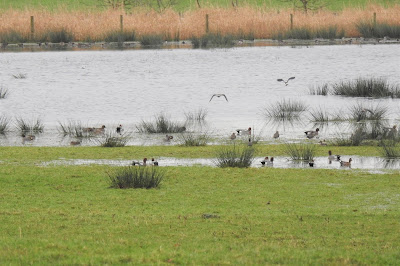
Robert and I had a quick look on the wetland just before the rain came in, and it was pleasing to note that the Teal were back, and numbered 250. Other wildfowl present included 12 Shovelers, 45 Wigeons and ten Mallards. There was a flock of twenty Lapwings on the margins of the wetland, along with a couple of Common Gulls.
 
Below are a few pictures of the wetland with Lapwings, Wigeon and Teal.


We didn't have a look in the woodland, but a flock of 30 Redwings and four Fieldfares were making their way across the tree tops, and a Jay flew across the track. 

Dare I say it, the forecast isn't looking too bad for this coming week, so hopefully I'll get plenty of surveying done, and maybe I can get rid of those feeding station blues with a ringing session next weekend. Fingers crossed!

Monday, 6 December 2021

Where were All The Teal?

On Sunday morning I visited the feeding station to top the feeders up. Unfortunately, it was too breezy for a ringing session, so that will have to wait for another weekend. The feeders were duly topped up, and Robert and I stood and watched for a while to see what was coming in. The usual suspects were there, such as Blue Tit, Chaffinch, Great Tit, Nuthatch, Coal Tit etc., but it was pleasing to note that at least 15 Tree Sparrows were visiting the feeder closest to the hedge. Tree Sparrows nest at the farm, and we ring the pulli from the boxes, so when we eventually have another ringing session, it will be interesting to see if we recapture any birds from the boxes. There was also four Moorhens hoovering up any spilt seed from below the feeders!
 
Tree Sparrow
 
Afterwards, we had a look on the wetland, and it was noticeable that there weren't many Teal, only four in fact. There were at least thirteen Shovelers and 78 Wigeon, so it seems unlikely that something had flushed the Teal. I then realised that it was probably the weather affecting the distribution of the Teal on site. The wetland has a fairly large open area of shallow water and grazed pasture along the northern edge of it, with rushes and a further open area of water within the rushes towards the back. The wind was cold, and from the north, and I suspect that the Teal were probably within the rushes, rather than feeding along the exposed northerly edge of the wetland. 
 
Teal
 
Also, just six days previous to this the wetland was frozen, and there didn't seem to be any wildfowl on it, or very few at best, and it might be that the numbers of Teal have been reduced because of this. I suspect that when I go again in a few days' time, there will probably be a few more. I hope so! 

Saturday, 4 December 2021

Winter Skyscapes

Thursday afternoon found me at one of my arable northwest Lancs wintering bird survey sites, under two oktas cloud cover, with a biting 2 - 3 NNW wind. And boy was it cold! That's the problem when you're standing still for several hours at a VP! In fact, I am looking at getting some of those heated socks; I must be getting old! I had some fairly good birds, including one that got away (more of that later), and some lovely skyscapes.
 
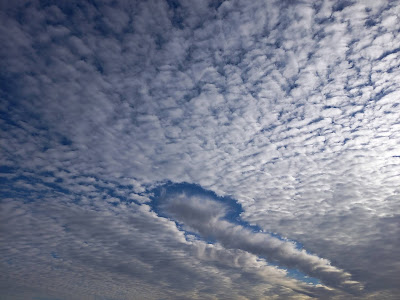
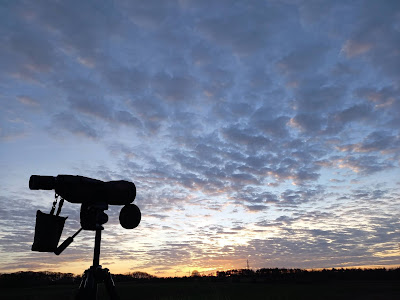
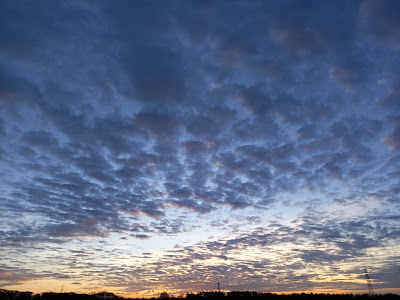
I'll start off with the skyscapes, with a series of pictures below illustrating how varied and quite spectacular they were. I was hoping for a decent sunset, but as the sun dipped towards, and below, the horizon, it just didn't happen. 


Not so many Brown Hares this afternoon, but nevertheless it was good to see at least two. Just to the north of my survey site, about 400 Pink-footed Geese kept lifting and dropping back down to feed, but they didn't budge from where they were feeding. A few Pinkies, 176 to be precise, flew over in different directions and in differing sizes of skeins. 
 
I picked this lone Pink-footed Goose as it flew high and north, and this is about 
the same view of it as I had. I just thought it made a good image against the sky.
 
 There was still quite a few Woodpigeons feeding in the stubble turnips, somewhere in the region of 115, alongside seven Stock Doves. Good numbers of Jackdaws and Rooks were either in the stubble turnips with the Woodpigeons, or else on an adjacent field of winter wheat, and they numbered 298 and 150 respectively. Later I watched them fly to some local woodland to roost.
 
A few Redshanks surprised me, and they were a new addition to the site list, the first being a flock of five that looked as though they were going to land on a fairly open pond in some stubbles, but they flew on instead. Every time I walk past this pond on my way to my first VP location, I walk close enough so I can see all the margins as it looks good for a Green Sandpiper or two. I then had four fly north, and a single bird on a field of fairly recently sown winter wheat. The second of three new species for the site, was also a wader, in the form of a single Jack Snipe. It did that classic Jack Snipe thing; flushed when I was nearly on top of it, and then didn't fly very far! 

The third new species for the site, was a cracking female Merlin that belted east past me at a rate of knots. You can't beat a Merlin. Other raptors that made an appearance were three Buzzards and two Kestrels. 

There are still quite a few Skylarks in the stubbles and this afternoon I had 46. The movement of thrushes seems to have finished now, but on my travels around the site I recorded four Song Thrushes, four Redwings and 38 Fieldfares. 

The bird that got away was at the end of my survey towards sunset. I heard a bird calling, and my brain, very casually just for a nano-second, said "Yellow Wagtail!" Of course, in that split second, I was telling myself not to be stupid as it was the 2nd December, and then it called again, and I noted that it had a harsh quality to it! I struggled to get onto the bird as it was obviously fairly high, but I did manage to get on to it as it was flying away from me, and into a bright sky lit-up by a setting sun, and all I can say is that it was a wagtail! Frustrating, but that's how it goes sometimes! 

I was supposed to be ringing at the feeding station tomorrow morning, but it is forecast to be too breezy, so I'll still go and top the feeders up and see what's coming in to feed. 
 
Over on the right you will see that I ahve updated the ringing totals for Fylde Ringing Group up until the end of November. Only one new species for the year was added during November and that was a single Fieldfare. 

Below you will find the top 5 ringed for November, and the top ten 'movers and shakers' for the year.

Top 5 Ringed During November

1. Linnet - 80
2. Redwing - 36
3. Greenfinch - 32
4. Blue Tit - 16
5. Long-tailed Tit - 15

Top 10 Movers and Shakers for the Year

1. Linnet - 310 (same position)
2. Lesser Redpoll - 161 (same position)
3. Blue Tit - 160 (same position)
4. Sand Martin - 123 (same position)
5. Greenfinch - 114 (up from 6th)
6. Goldfinch - 111 (down from 5th)
7. Chaffinch - 94 (same position)
    Great Tit - 94 (same position)
9. Meadow Pipit - 81 (down from 7th)
10. Redwing - 75 (straight in)

Wednesday, 1 December 2021

Snow Go

This is just a quick update really, jut to let you know that I have nothing to report! On Sunday morning Gail and I were due to have a ringing session at the feeding station, but when we got up at 6:30 a.m. it said 'snow'! Where did that come from? I knew it was going to be cold, but there was no snow in the forecast the day before. 

For obvious reasons, we can't be catching birds for ringing in such inclement conditions. As it happened, the snow didn't come in until later in the morning, so we might have managed a short session, but even if we had, we would have ended up with a wet mist net, which at 60 foot long is a bit of a nightmare to dry!

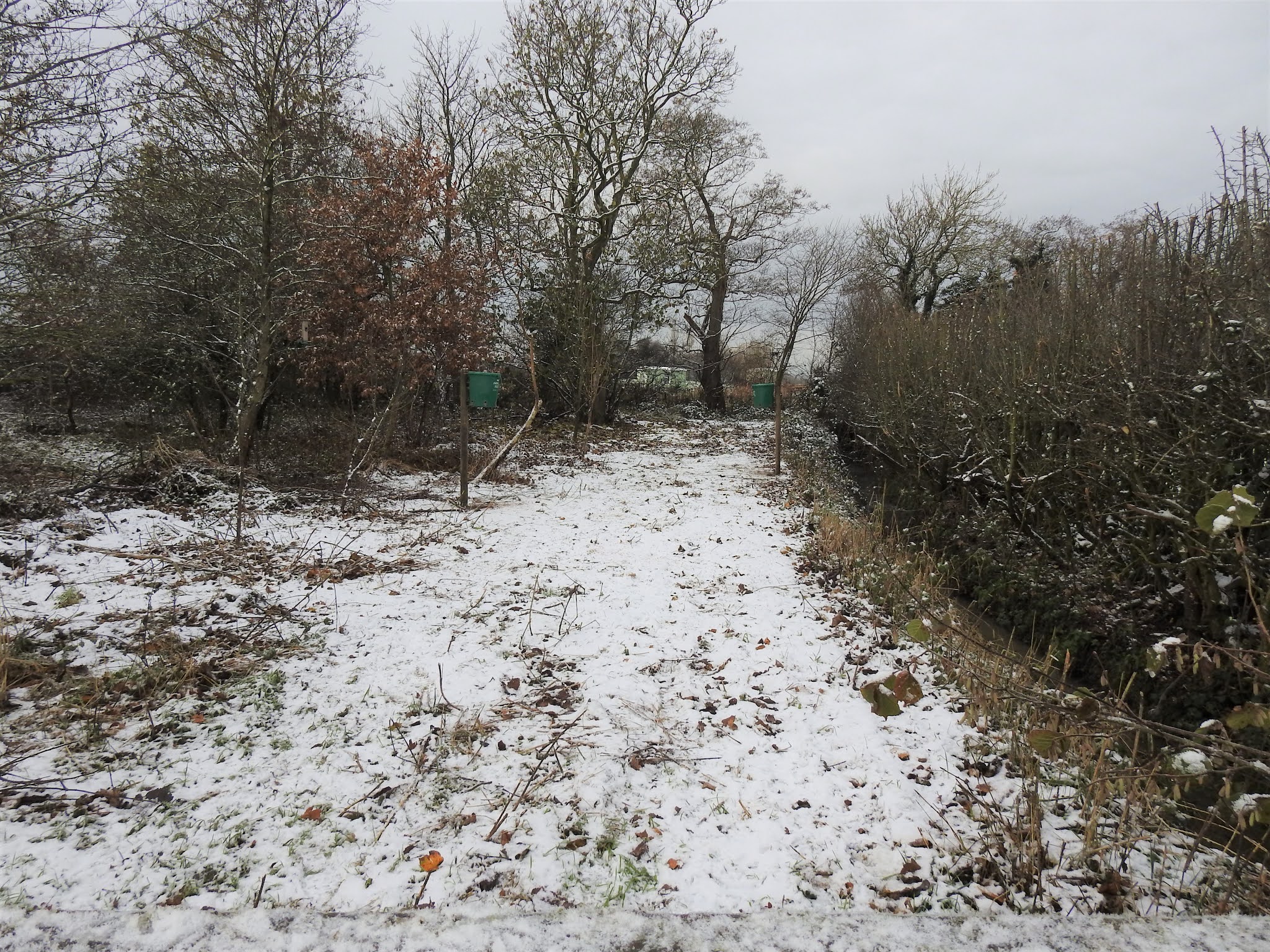
On Monday, Gail and I went to the feeding station to top the feeders up, and it was another cold and frosty morning, as you can see from the picture below, with a dusting of snow still present. After the feeders were duly topped up, we had a look on the wetland, but it was devoid of any waders and wildfowl because of the freezing conditions. There was only one thing to do, and that was to join Robert and Diana in their cosy farmhouse and drink a gallon or two of coffee! 
 
A snowy feeding station
 
The forecast is looking like I'll get a couple of surveys in towards the end of the week, with perhaps a ringing session at the feeding station at weekend. I'll let you know.

Sunday, 28 November 2021

It's the survey season...

..., or so it would seem, based on the number of wintering bird surveys I have completed of late! Over the past ten days I have completed seven surveys, and had a ringing session at our new feeding station in between. I'm not complaining at all, because it means we have had a spell of decent weather, and long may it remain so. 

In my last post I talked about all the 'Vikings' that were around at the time, and since then there has been more of these Nordic birds arriving, but over the past few days this has slowed down. I am still hearing Redwings and the odd Blackbird moving at night, but the calls/minute that I record as a measure of how heavy the passage is, has reduced. 

I have five wintering bird survey sites this year, and all except one in west Lancashire, near Ormskirk, are close to home. On 16th November, I was at one of my arable sites in northwest Lancs under full cloud cover, with a 10 mph south-westerly wind. At this particular site all the arable land has now been sown with winter wheat, which the Brown Hares seem to be enjoying, and on this morning, I recorded nine of these stonking mammals. 

Watching the Brown Hares reminded me of a poem by Robert Macfarlane about Mountain Hares, but his description of how the Mountain Hare moves is equally applicable to Brown Hares.

Hare, walking, is graceless lollop,
Awkward piston, awkward shunt.
Running, hare smooths sudden into speed,
flows over hill-top, lee-slope - 
Each quick arc a mark of hare, a sign of hope
 
Absolutely brilliant. Awkward piston, awkward shunt, I love it, such a perfect description! 

Most of my wintering bird surveys are connected to the fact that most of Lancashire falls into what is known as a 'Pink-footed Goose and Whooper Swan wintering area', but the only Pink-footed Geese I recorded were 164 flying over. In addition to the Brown Hares making use of the winter wheat, eight Stock Doves and 176 Woodpigeons were also foraging in these areas. 
 
Raptors were represented by a female Sparrowhawk, a male Kestrel and two Buzzards, and for the second week running I had a calling Chiffchaff. I mentioned that I had some more Vikings, and this morning was no exception, with six Song Thrushes, 263 Redwings, 13 Blackbirds and 205 Fieldfares present. 
 
One of my wintering bird survey sites has nothing to do with wintering Pink-footed Geese and Whooper Swans, it is an enlightened land owner who is interested to know what is on their farm over winter. Again, it is northwest Lancs, and under 7 oktas cloud cover, with a 2 - 3 NW wind, I had a wander along the hedges, round the ponds and through the woodlands, the day after my previous survey. 
 
I recorded 26 bird species on my wander round, and there were a number of species absent that I'm sure I'll pick up later in the winter. That's the problem with surveying, it is just a snapshot of what you encounter on one particular date, and that's why a number are completed during the winter to try and smooth out the peaks and troughs. 
 
When I was undertaking this survey, I was recording quite a number of Blackbirds, and I started to think back on other recent surveys, and I realised that I was recording a good number of Blackbirds on all of my surveys. It would seem that there has been quite an arrival of them with Redwings and Fieldfares. Looking through them, I could pick out several continental male type Blackbirds, indicating that a high percentage of the Blackbirds that I was recording, were arrivals from Scandinavia. When I counted up from my survey maps, I could see that I had recorded 23 Blackbirds alongside seven Song Thrushes, a Mistle Thrush, 34 Redwings and ten Fieldfares.
 
I can't resist photographing Gorse, mainly because it gives you a lift with its 
bright yellow flowers in the dark of winter. And often you smell it first, with 
that delicate coconut scent, before you see it. There was plenty of Gorse in
flower at this site.
 
 
My third morning surveying 'on the bounce' found me again in northwest Lancs at my other arable farm under full cloud cover, with a 3 - 4 westerly wind. This was an afternoon survey to cover the dusk period, and throughout the afternoon I was plagued with showers, and some of them were heavy, causing me to scurry to the nearest hedge and take shelter. In fact, I was about to call the survey off as the sun started to set, but thankfully it stopped raining and brightened up. 
 
Sunset after the rain cleared
 
I've mentioned before that close to one of my VP locations is a fishing lake that I can see part of, and this morning there were two Gadwalls on it, which was a new species for me for the site. Woodpigeons were feeding amongst the stubble turnips, which is quite a weedy crop, and I had 505 of them, but I could only see two of their Stock Dove cousins. 
 
I added another new species for me for the site, in the form of 14 Black-tailed Godwits that were heading north. A flock of 42 Skylarks and 53 Linnets in some of the stubbles was noteworthy, and the best of the rest included 138 Black-headed Gulls, a female Sparrowhawk, two Buzzards and Kestrels, 112 Jackdaws, 96 Rooks, a Raven and three Song Thrushes. There's been a few Songies about this autumn on the quiet. 
 
Last weekend, Alice, John and I had our first ringing session at our good friends Robert and Diana's farm near Garstang. We managed to ring 36 birds as follows:
 
Great Tit - 12
Blue Tit - 11
Coal Tit - 2
Robin - 1
Chaffinch - 5
Blackbird - 1 (continental female)
Great Spotted Woodpecker - 1
Nuthatch - 2
Treecreeper - 1
 
The masked bandit, aka a Nuthatch
 
We were quite busy, so birding records were thin on the ground, but did include 57 Redwings, a Tree Sparrow, a Siskin, a Grey Wagtail, a Lesser Redpoll, a Kestrel and that Fylde scarcity, a Bullfinch. I didn't see the Bullfinch, I could just hear it calling. 
 
Earlier this week at another of my northwest Lancashire survey sites, this time all permanent pasture with hedgerows, ponds and scrub, I again noticed that there seemed to be quite a few Blackbirds. I counted up, and I had recorded at least 25. Another numerous species was Magpie, and I had 24 feeding in some maize stubbles!  
 
My second VP is next to a fairly large pond, and for the two hours that I 
was stood there, this Grey Heron kept me company. At one stage I watched it
catch a large frog that was covered in bits of mud and debris from the bottom
of the pond, and the Heron kept dipping the frog in the water to rinse it, before
swallowing it down in one! 
 
Mid-week I was down in west Lancashire surveying some arable farmland with a mix of stubbles and field vegetables. I was in my position at my VP half an hour before first light, and the first birds that I recorded, were a small group of eight Whooper Swans winging their way north, presumably to some feeding areas out on the moss. Pink-footed Geese were doing exactly the same, and I had 1,221 moving over in various directions. 

I have surveyed this site previously, about 3 - 4 years ago I think, and one of the features then was the number of Mistle Thrushes I recorded, and today was no different, as I had at least five of these beautiful, monster thrushes. The stubbles held a flock of 89 Linnets, and 104 Lapwings and a calling Corn Bunting over were pleasing to note. 

The following day I was back closer to home surveying, and it was Blackbirds and Magpies that featured again, with counts of 19 and 53 respectively! Gail and I should have been out ringing again this morning, but when we got up at 6:30 a.m. a quick check of the forecast before we headed out showed sleet/snow in the forecast where we were going, and very obviously, this isn't conducive to ringing!

And that's about it. I'll be out and about later in the week if the weather plays ball, so fingers crossed for some more decent weather!