Saturday, 14 September 2019

Working Out The Vis On The Eastern Solway

Earlier in the week I was birding at what has become a semi-regular local patch for me on the Solway near Rigg, in Dumfries and Galloway. As I have hinted at previously, I hope that in the not too distant future it will become a more regular local patch! It's always interesting, even exciting, finding new local patches and trying to work out the dynamics of the site. A point in question is the 'vis' at this site.

 The Solway

There was a bit of vis on this morning, the majority of it heading east/southeast. Birds seemed reluctant to cross the Solway, and I wondered if this is always the case, or is it bit like Morecambe Bay at the Obs and is weather dependent. On clear days birds will head south from Walney, completely missing landfall at the the southern mouth of the Bay where the Obs is, as we pick birds up at sea heading south. On less clear days, perhaps the majority of days when birds are on the move, we record birds heading east or west, in essence heading in and out of the Bay. The Solway is of course a large bay too, and maybe the majority of birds head in and out here as well. Hopefully time will tell!

I had four oktas cloud cover, with a light westerly wind when I parked my car overlooking the Solway near Rigg. I like to set my scope up first and have a look at the birds feeding on the shore, or drifting in and out on the tide. A number of Snipe were on the shore and I counted 25. I'm used to seeing Snipe flying away from me at the Obs as I put them up from one of the wetlands, so it was a pleasure to watch them feeding away.

The most numerous wader species was Lapwing and I counted 237 in total. Other wader species included two Curlews, four Oystercatchers, 126 Redshanks, five Greenshanks, two Golden Plovers, two Curlew Sandpipers and 51 Dunlin.

Returning to the vis I had a few bits and pieces, moving mainly easterly as I stated above. Species on the move were two Grey Wagtails, 21 Meadow Pipits, eight Skylarks, four Swallows and a Tree Pipit.

There was a number of butterflies about either feeding from flowers on the edge of the merse, or on flowers on the merse itself. I counted three Red Admirals, seven Painted Lady's, a Green-veined White and two Small Tortoiseshells. Looking at these figures I can see that I didn't count everything, I was probably just enjoying watching them too much!

 Painted Lady

After a quick call to a local supermarket to purchase some Orkney Brewery ales it was time to cross back over the border.

Sunday, 8 September 2019

Which Morning?

On Friday evening I was faced with a dilemma as to which morning over the weekend to do some ringing at the Obs, as the forecast was reasonable for both Saturday and Sunday. In terms of wind strength and direction, it was marginally better for Sunday with a forecast 5 mph southeasterly wind, and for Saturday morning a 9 mph northerly! Normally I would have gone for Sunday, but Saturday morning would be the first morning for several days when it would be fit for some vis, and maybe the vis dam would burst!

I was at the Obs early Saturday morning unlocking and then locking the three gates that give us access to the ringing area in one of the reedbeds and Willow scrub. I was there a tad early, as I had to use my head torch to see to unlock the gates and to find the guy ropes to put up the nets! The day dawned with three oktas cloud cover and a 10 mph northerly wind.

A few Alba Wags went over heading north, rather surprisingly, until I realised that they were probably dispersing from an overnight roost at a chemical plant to the south of the site. I didn't hear any Swallows exiting their reedbed roost alongside one of the pools, probably as a result of the poor weather during the week breaking up the roost and preventing any further movement. The Starlings exited their roost in their customary late fashion, considerably later than sunrise, and they numbered at least 6,000.

There was some vis, but it didn't really start until a couple hours after first light, when it had warmed up. As it's early September the passage wasn't heavy, and as I was situated between the coast and the estuary the vis isn't always as obvious here. I had no more than a hundred Meadow Pipits head south and 46 Pink-footed Geese (my first of the Autumn), with a handful of House Martins, Linnets, Grey Wagtails, Skylarks and Swallows.

Grounded migrants were thin on the ground, and with the exception of a single Goldcrest, are probably reflected in what I ringed. I ringed sixteen birds (no recaptures) as follows:

Blue Tit - 2
Blackcap - 3
Linnet - 1
Whitethroat - 2
Reed Warbler - 2
Robin - 2
Wren - 2
Chiffchaff - 1
Blackbird - 1

 Blackcap

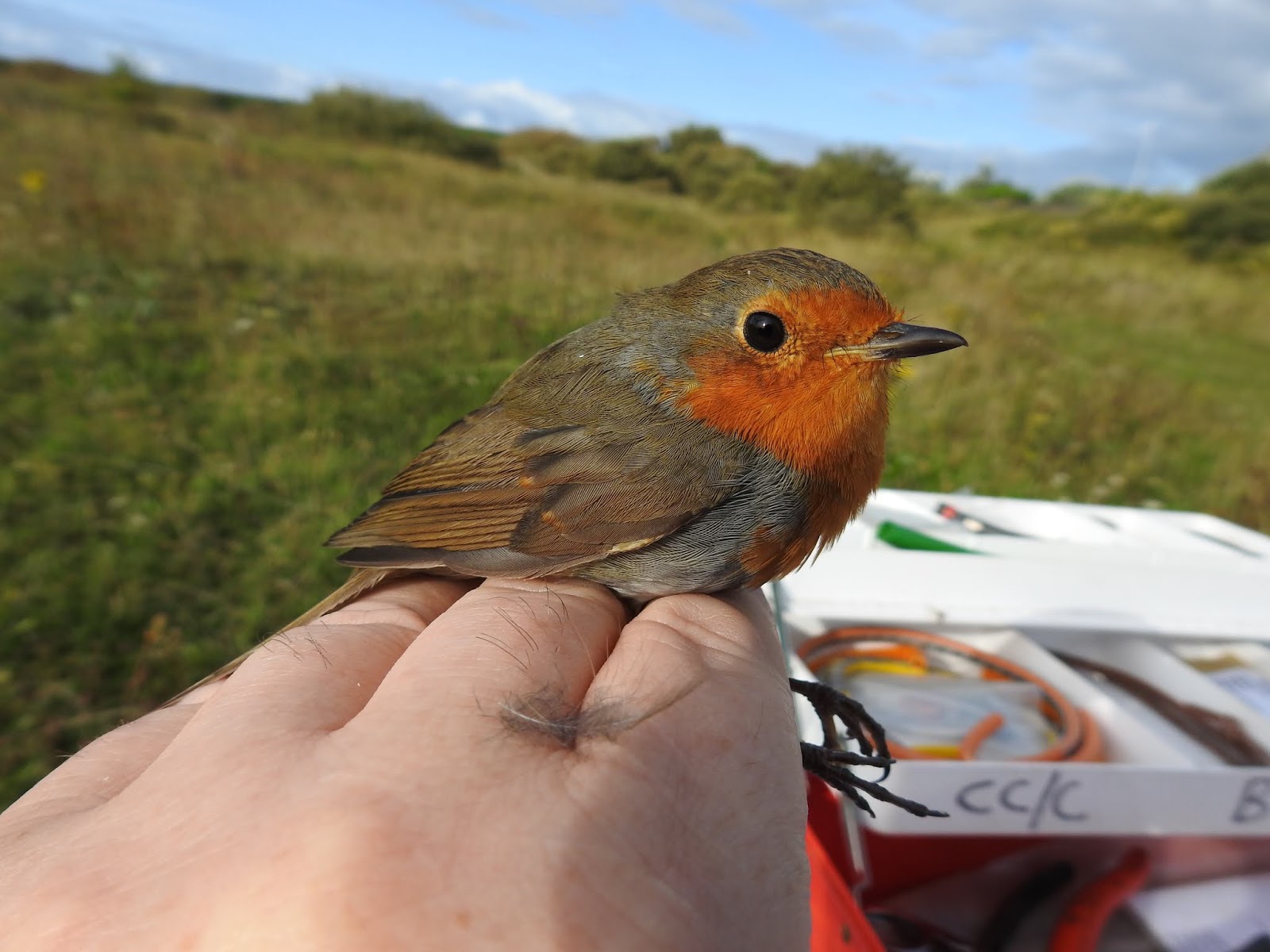
 Robin

Not much else made it in to my notebook 27 Coots, four Little Grebes, seven Tufted Ducks, two male Pochards and a Cetti's Warbler.

I'll hopefully be birding on the Solway in Scotland on Tuesday after one of my surveys in north Cumbria. So I'll let you know if I do.

Wednesday, 4 September 2019

Minor Changes

I've made a few minor changes to my Blog description, and also to the introduction to my profile, to reflect more the area that I now spend my time immersed in Natural History. I tend to be spending less of my time recording and observing wildlife in the Fylde area of Lancashire, but more of my time in Cumbria and Dumfries and Galloway. Partly because of my work, but partly because I like those areas. In fact either or will hopefully become home in the not too distant future.

A week ago now I was at one of my survey sites in the North Pennines, in the upper Eden Valley in fact, on a glorious sunny day with a light south-southwesterly wind. It is quite a bleak site in it's position in the landscape, and whenever I view it in my mind's eye it always seems cold and overcast. But today was one of those days that proves it can be a beautiful spot when the sun shines!

As I drove along the farm track to the plantation woodland (seven compartments here) I had to move some very stubborn sheep from the track. I was about to say that they had obviously roosted on the track (bird parlance) overnight, but what I do mean is that they had obviously slept on the track overnight. They weren't for moving, not even when sounding my horn or revving  the engine; I had to get out and 'encourage' them out of the way. 

Driving to where I park my car I had a first record for the site in the form of a female Wheatear. Nothing unusual, but even common species can be patch megas, and that's the beauty of getting to know a site intimately. 

Willow Warblers were yet again a feature of the morning, as they have been during all of my surveys recently, and I recorded a respectable 16 birds. Other warbler species included four Blackcaps and a Chiffchaff. I always record a few Song Thrushes at this site and this morning was no exception with four making it in to my notebook. The best of the rest included four Grey Wagtails, 13 Lesser Redpolls (including a juv.), three Meadow Pipits south (my first on vis for the Autumn), 42 Goldfinches, 33 Swallows, two Siskins, a Buzzard and a Sparrowhawk.

On Monday I had another survey not too far from Kendal. Gail accompanied me this time with the promise of a walk on Foulshaw Moss, and breakfast with retail therapy at Low Sizergh Barn Farm Shop & Cafe; I think it was the latter that encouraged her out of bed before first light!

 Rowans looking like Christmas trees with a heavy load of berries and a 
silvery dew on their leaves

This is one of the few sites where I regularly record Bullfinches, and we had two this morning. Other bits and pieces included a male Sparrowhawk that flew very low over our heads, four (more) Willow Warblers and a Song Thrush; a fairly quiet one.

We then headed to one of our favourite sites, Foulshaw Moss, before a breakfast barm beckoned! We spent about an hour and a half on the Moss dodging the showers that were driving in. In Cumbrian terms Foulshaw Moss is a popular place with visitors and it is a site that Cumbria Willdlife Trust try and sign up members at. I like going there because it is a wonderful place for wildlife and compared to the reserves I'm used to in Lancashire, it is quiet!

There are two feeding stations in operation at Foulshaw Moss and this morning they were busy as always. Numbers of Blue and Great Tits were visiting constantly, as were about 20 Tree Sparrows, 20+ Goldfinches, a few Greenfinches, the odd Reed Bunting and a few Chaffinches. Apologies for the not very accurate or scientific counts, but it really is hard to tell how many birds visit feeders, unless you are catching and ringing them of course.

 One of the feeding stations

A Tree Sparrow on a feeder at the other feeding station

A few Chiffies and Willow Warblers hung on, and we had a few Tree Pipits over heading south before the rain showers came in. Probably the best bird of the morning was a juv/female type Marsh Harrier that was putting all the wildfowl up as it quartered the moss.

I've mentioned before the local amenity woodland that I walk to and around to stretch my legs when I am in the office all day, well yesterday I had another mega on one of the ponds in the form of a Cormorant! Again, like the Great Crested Grebe I had recently, not a scarce bird at all, but the first that I have recorded at the site, so a little bit of patch magic!

The weather has been appalling of late, but there is a window of opportunity tomorrow morning for me to get a survey in under the shadow of the mighty Blencathra in the north Lakes, and fingers crossed some ringing on Sunday!

Friday, 30 August 2019

Season Of Mists...

...and mellow fruitfulness,
Close bosom-friend of the maturing sun;
Conspiring with him how to load and bless
With fruit the vines that round the thatch-eves run;
To bend with apples the moss'd cottage-trees,
And fill all fruit with ripeness to the core;
To swell the gourd, and plump the hazel shells
With a sweet kernel; to set budding more,
And still more, later flowers for the bees,
Until they think warm days will never cease,
For Summer has o'er-brimm'd their clammy cells.


As you will probably know the above is the first verse of one of my favourite poems, 'Ode To Autumn', by John Keats. It is so evocative of Autumn, which of course it is meant to be, and I love all the bird references contained therein. On Bank Holiday Monday morning as I drove to one of the reedbeds at the Obs it most certainly was season of mists as one of those low autumnal mists carpeted the farm fields. I was meeting Alice and Ian at 5:30 am, and it didn't bode well for our impending ringing session.

I was there first and as I waited for Alice and Ian to arrive I could hear Swallows exiting their reedbed roost giving that exquisite twittering that I think sounds more urgent in Autumn, or is that just me thinking about the season? It was impossible to tell how many because of the mist, but there was a fair few.

Next up were the Starlings and they were visible and numbered at least ten thousand. The noise from their wings always reminds of waves rolling on to the shore. Superb!

Who hath not seen thee oft amid thy store?
Sometimes whoever seeks abroad may find
Thee sitting careless on a granary floor,
Thy hair soft-lifted by the winnowing wind;
Or on a half-reap'd furrow sound asleep,
Drows'd with the fume of poppies, while thy hook
Spares the next swath and all its twined flowers;
And sometimes like a gleaner thou dost keep
Steady thy laden head across a brook;
Or by a cyder-press, with patient look,
Thou watchest the last oozings hours by hours.


The mist certainly did have a negative impact on our ringing session, and indeed on any migration monitoring at the Obs at all, by way of preventing any vis. It certainly 'felt' very quiet in the reeds and scrub as we put the nets up. We did manage to ring twenty birds, which was a bit of a bonus considering the conditions. The twenty ringed were:

Reed Warbler - 3
Blackcap - 7
Cetti's Warbler - 1
Great Tit - 1
Lesser Whitethroat - 2
Whitethroat - 2
Wren - 1
Chiffchaff - 1
Long-tailed Tit - 1
Blue Tit - 1

 Cetti's Warbler

Lesser Whitethroat

A few bird calls drifted through the mist including Sandwich Tern and Whimbrel, but how many? After a couple of hours we decided to cut our losses and call it a day.

I'll leave the final words to John Keats!

Where are the songs of Spring? Ay, where are they?
Think not of them, thou hast thy music too -
While barred clouds bloom the soft-dying day,
And touch the stubble-plains with rosy hue;
Then in a wailful choir the small gnats mourn
Among the river sallows, borne aloft
Or sinking as the light wind lives or dies;
And full-grown lambs loud bleat from hilly bourn;
Hedge-crickets sing; and now with treble soft
The red-breast whistles from a garden-croft;
And gathering swallows twitter in the skies.

Saturday, 24 August 2019

More Than A Hobby

I suppose I am fortunate, or maybe not so, that all things ecological provide me with my 'bread and butter' as well as being a life long absorbing passion. One thing is certain, and I know I have said this before, that it has been my 'bread and butter' birding that has been providing with my natural history fix. And that has certainly been the case over these past ten days or so!

Anecdotally, it would seem that some bird species have had a good breeding season, and Willow Warblers being one of them. About ten days ago I was at one of my woodland plantation survey sites near Penrith in Cumbria, and I was listening to a Willow Warbler giving a bit of that late summer/autumn sub-song. I decided to 'pish' and see if it responded, and perhaps I would be able to obtain a snap or two. The 'pishing' worked, as five popped out to see what I was, or what I was up to!

Did I obtain the 'snap' I was looking for? I think the series of three pictures below answer that question, and the answer is no!


 The Willow warblers would occasionally forage on the ground on bare
earth, as this individual showing us it's back is demonstrating1


In total I recorded fifteen Willow Warblers during my survey, including three giving that sub-song that I mentioned. I had a Tree Pipit over high, my second of the autumn I think, and the other highlight was the flock of 27 Tree Sparrows that I saw take off from one of the wooded compartments, circle round gaining height, and then heading off south en masse! I have seen this before at this time of year, and I assume it is birds using the plantation to roost before heading off to feeding areas. The 'best of the rest' included three Buzzards, a Raven, 53 Goldfinches and a Song Thrush.

I've mentioned before a piece of woodland locally that I walk to if I am having a day in the office, to stretch my legs and get a breath of fresh air. Being a Naturalist and a habitual keeper of notebooks (I have every notebook back to when I started birding in 1976!), when I do this walk I record everything I see and hear in the woodland. Within the woodland are two ponds, and on the way to the woodland I pass another pond. The ponds contain mainly Mallards, with perhaps a pair or two Moorhens on each of them. There is very little marginal vegetation on either of them, probably as a result of the large number of Mallards and being surrounded by trees.

All of the ponds have Terrapin sp. in them, probably unwanted pets that have been released there, and the most common Terrapin found in UK water-bodies is the Red-eared Terrapin. As one website that I looked at said, originally they were native to Britain around 8,000 years ago and have returned, transported from the USA as pets during the Teenage Mutant Hero Turtles cartoon craze of the 1980s! Anyway, my reason for mentioning them is that they are part of the picture that I am trying to convey that these ponds aren't the best when it comes to biodiversity!

I have recorded the odd Grey Heron, and for a couple of years I had an over-wintering Coot, but over the past week or so there has been a Great Crested Grebe on one of the ponds! This has got me really excited, sad I know, but it just goes to show the pleasure you can get out of watching a local patch!

Yesterday, Gail and I headed to one of my plantation woodland survey sites in north Cumbria near Wigton. Willow Warblers were once again a feature of the morning, but it was an adult Hobby that made the headlines! Whilst walking through the trees counting, recording and mapping we heard some Swallows alarm calling, and I thought "there's a raptor about"! As we approached the southern edge of the trees I thought I saw a larger bird (larger than the Swallows that is) trying to alight on some telegraph wires. I later realised that it was probably the Hobby stooping at some perched Swallows! When we came out of the trees we were greeted with the sight of a 'red trousered' adult Hobby flashing past over our heads! It made a few passes over the trees chasing and stooping in attempt to catch some Swallows. After what was probably just seconds, though it seemed longer, it gained height and we lost it over the trees. Stonking!

I mentioned Willow Warblers again being the feature of the morning, and they were with nine recorded, but otherwise it was quiet with just eight Stock Doves, a singing Chiffchaff, two Great Spotted Woodpeckers, a Blackcap and two Goldcrests making it from my map to the pages of my notebook.

We then had a three-fold mission over the border; a trawl around about a dozen houses in southeast Dumfries and Galloway to see what we could get for our money, a look on the Solway near Rigg and to procure a selection of Orkney Brewery beers!

We drove past and stopped to look at about a dozen houses in various towns and villages around Annan and Gretna, and we even had a larger cousin of the Hobby whilst looking at one particular cottage; a juvenile Peregrine headed low south across some fields and away!

Down on the Solway Gail went off foraging for Blackberries, having already foraged some Hazelnuts during our earlier bird survey. It's certainly been a good year for Hazelnuts, and there's a smashing crop. She only takes a few from different trees to ensure that nearly all of them remain for Red Squirrels, small mammals and other wildlife.

Back to the Solway. A number of waders, although not the usual varied selection, were feeding on the mud at the edge of the merse and I had three Greenshanks, 34 Curlews, 709 Lapwings, five Oystercatchers and nine Redshanks. In addition to the waders on the mud were 217 Black-headed Gulls and three Little Egrets. On the river were 17 Mute Swans (no sign of the over-summering Whooper Swan), nine Mallards, a Wigeon and just four Goosanders.

On the edge of the merse was a patch of mint and it was full of bees, nearly all Buff-tailed Bumblebees. I tried to get a few shots (below), but it was a tad windy and the mint was certainly waving about with the bees clinging on.

 Buff-tailed Bumblebee (above & below)


A successful tub of foraged Blackberries later, and the aforementioned Orkney ales procured, it was time to head home, but I don't think it will be long before we're back on the Solway!

Sunday, 11 August 2019

Sunshine On the Solway

August has been quite a rough old month so far, and the weather Gods haven't been smiling on us when it comes to getting out ringing at the weekends. Last Thursday, the last sunny day before the wet windy westerly weather we are having at the minute came in, I had a very pleasant morning on the Solway in southwest Scotland near Rigg.

 The Solway

Before I hopped over the border to the Scottish side of the Solway, I had one of my plantation woodland bird surveys to complete at a site not a million miles from Carlisle. One thing I have noticed this year is that there seems to be a good berry crop on the Rowans, and Hazel seems to have done well too. The local Blackbirds were certainly enjoying the Rowans at this site.

 A good crop of berries on the Rowans

The best birds during my survey were three Ravens that flew over croaking, and the supporting cast included eight Willow Warblers, a Great Spotted Woodpecker, a Chiffchaff, a Buzzard, three Stock Doves, a Tree Sparrow and a Mistle Thrush.

After I finished my survey and headed over the border to Scotland, to the area that Gail and I hope to call home in the next couple of years, it started raining fairly heavily. It wasn't forecast to rain, but thankfully as I got closer to the Solway the sun started to shine, and it was nice for the remainder of the morning.

I parked up and set my scope up at the rear of my car and started scanning the shore. I say the shore, but when I first arrived the tide was still in and had only just started to fall. The Solway itself was as flat calm as a mill pond, and looked spectacular with the cloud formations reflecting in the water.

As the tide dropped and mud started to appear, then birds started to drop in. A nice group of five Greenshanks fed in front of me, but sadly I was looking into the sun and couldn't get any pictures. Greenshanks are one of my favourite birds and I never tire of watching them, particularly when they are feeding. I'll leave it to Desmond and Maimie Nethersole-Thompson to describe their feeding behaviour from their seminal monograph 'Greenshanks':

"In summer Greenshank's use different methods to capture their food. We have seen them running through the shallows with high steps; possibly the origin of the cock's goose-stepping approach to hen courtship. In this way they probably flush small fish or aquatic insects. At other times they run quickly, holding up one or both wings while they dab rapidly from side to side, taking insects from the surface or just below it. In these pursuits the bird sometimes turns through an angle of at least 180⁰. Another familiar method is running with half-immersed bill swinging from side to side in the water".

Brilliant!

As the tide dropped further other birds started to appear; five Little Egrets, a Grey Heron, eight Black-tailed Godwits, seven Curlews, 80 Lapwings, 27 Redshanks, six Oystercatchers, 67 Dunlin and five Bar-tailed Godwits.

On the river were 34 Goosanders, 18 Mute Swans and three Shovelers. Amongst the Mute Swans was a Whooper Swan, and I'm guessing it was the same bird that I had here on 2nd May. In May I thought it was perhaps injured, but I did see it fly downstream, albeit not very strongly. So, presumably it has over-summered because of an injury and hasn't been able to return to Iceland.  

 Whooper Swan

August is the peak month for Tree Pipits and I had my first of the autumn go over. I couldn't see it, but I could hear it. I find it hard to describe calls, in terms of the written word, so I had a look in the Collins Bird Guide that describes the call as "a drawn-out, uninflected, hoarse 'spihz'". I couldn't have put it better myself!

As the morning progressed and the clouds retreated a number of butterflies were on the wing and I recorded fifteen Painted Lady's, six Red Admirals, 18 Small Whites, eight Walls, two Large Whites, a Small Copper, two Meadow Browns and a Peacock.

 Painted Lady

Peacock

Red Admiral

Small Copper

Wall

If the weather improves this coming week I hope to be out and about surveying in Cumbria, with hopefully some ringing back at the Obs too!

Friday, 9 August 2019

Scotland to Ireland, But Not Via the Old Scotch Road

There's been a lot of Painted Lady butterflies about recently, and you have probably noticed this. Before I headed off on my visit to Ireland I was giving my car one of it's rare cleans over a lunchtime period towards the end of July, and I had about thirty heading in a generally northerly direction. In fact, right up to heading off to Ireland in early August I was seeing Painted Lady's everywhere I went.

The purpose of our trip to Ireland was to take my Mum's ashes back to the village where she came from. We stayed with my Auntie and Uncle, and as a thank you for putting us up I decided to purchase some chocolates from Kennedy's Fine Chocolates in Orton, which are the best chocolates I have ever tasted by the way and I can't recommend them highly enough. In fact if you click here it will take you to their website. Anyway, I digress!

The reason for mentioning this, is that often when I drive to Kennedy's I drive a long the Old Scotch Road, and I thought I would stop on my way back and have a look along it's wide verges to see if there were many Painted Lady's up here. I walked a section further north this time, and this section is away from the motorway, so it is quieter and one can enjoy the fabulous views in a more pleasant environment.

 The Old Scotch Road

It was quite blustery as I walked along and I think this had a negative impact on butterfly numbers, and in fact I didn't record any Painted Lady's at all! The only butterflies I had were a Small White, five Ringlets and a Small Tortoiseshell.

 And the Old Scotch Road with Wainwright's sleeping Elephants in the 
background (aka the Howgills)

Last weekend, as I mentioned above, Gail and I had a trip to Ireland. We sailed from Cairnryan to Belfast, and during the crossing I like to sea-watch. I divide the crossing into three sections; Loch Ryan, North Channel and Belfast Lough. On the outward crossing I record on Loch Ryan and the North Channel, and inward on Belfast Lough and again the North Channel.

On our outward crossing my totals for Lough Ryan included 36 Gannets, five Guillemots and six Manx Shearwaters. My totals for the North Channel included 175 Guillemots (with lots of young birds accompanied by adults), 23 Gannets, 43 Manx Shearwaters, a Storm Petrel, two Fulmars, thirteen Kittiwakes, five Puffins, three Razorbills, a Great Skua and two Harbour Porpoise.

As the purpose of our visit to Ireland was to return my Mum to her village we didn't really have much time to do any birding. We managed to fit in a visit to the National Trust's Mount Stewart estate, overlooking Strangford Lough, and completed a four mile walk of the demesne. We had a look at the wildflower meadow, and here we recorded a few Painted Lady butterflies, but the only birds that found their way into my notebook were four Goldcrests and a pair of Hooded Crows.

 The Mount Stewart wildflower meadow

Cornflower

The return sea crossing to Scotland included two Black Guillemots, six Common Terns, a Gannet, 16 Guillemots, nine Manx Shearwaters and a Razorbill in Belfast Lough. Whilst in the North Channel we had 54 Manx Shearwaters, four Kittiwakes, 64 Guillemots, 135 gannets, nine Razorbills and eleven Fulmars.

The drive back through Dumfries and Galloway on the A75 yielded a couple of ubiquitous Red Kites!

Over on the right you will see that I have updated the ringing totals for Fylde Ringing Group up until the end of July. During July five species were added to the years' totals and these were Sedge Warbler, Garden Warbler, Tawny Owl, Redstart and Spotted Flycatcher.

Bedlow you will find the top ten 'movers and shakers' for the year and the top five ringed for the month.

Top 10 Movers and Shakers

1. Lesser Redpoll - 106 (same position)
2. Great Tit - 97 (up from 5th)
3. Blue Tit - 89 (up from 6th)
4. Goldfinch - 88 (down from 3rd)
5. Pied Flycatcher - 80 (down from 2nd)
6. Blackcap - 68 (up from 9th)
7. Linnet - 67 (down from 4th)
8. Willow Warbler - 53 (up from 10th)
9. Sand Martin - 47 (down from 7th)
10. Chaffinch - 39 (down from 8th)

Top 5 Ringed in July

1. Blackcap - 46
2. Willow Warbler - 36
3. Great Tit - 33
4. Blue Tit - 27
5. Chaffinch - 15