Wednesday, 30 October 2019

Just Greenfinch Town This Time

I kicked the week off the week with a ringing session in one of the reedbeds and scrub at the Obs. It was a frosty start and I had clear skies with a 5-10 mph NE wind.

From the word go there was some vis, but as usual under clear skies it was high, and also as I was busy operating mist nets and ringing it was difficult for me to monitor it accurately. So all I am going to mention are the species involved, without counts, and these were Brambling, Fieldfare, Redwing, Goldfinch, Woodpigeon, Starling, Lesser Redpoll, Siskin, Skylark, Chaffinch and Pink-footed Geese. A couple of the species that I did count were the 482 Jackdaws and four Whooper Swans south.

 Pink-footed Geese

Whooper Swans

A couple of Cetti's Warblers and a Water Rail called from the reeds, and about ten Snipe dropped on to the new scrape. A pair of Stonechats moved around the edge of the pool, and a male and female Sparrowhawk caused mayhem at different times of the morning. The only other raptor I had was a single Kestrel, and a Great Spotted Woodpecker is still fairly noteworthy in this landscape with little tree cover.
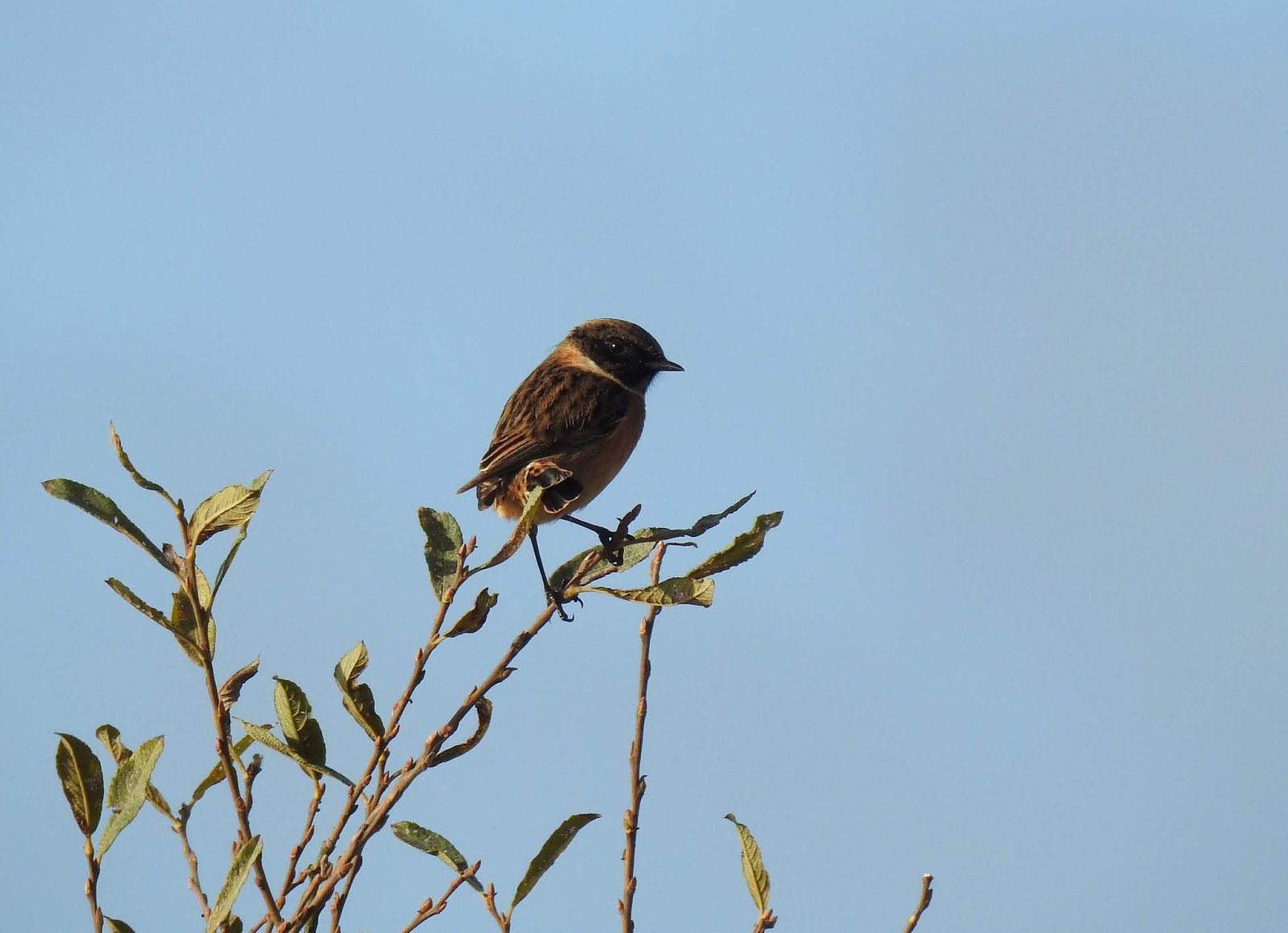
 Stonechat

I ringed 29 birds as follows:

Fieldfare - 1
Blackbird - 1 (continental male)
Greenfinch - 20 (not a city this morning, rather a town!)
Lesser Redpoll - 2
Cetti's Warbler - 1 (that's 14 for the site this year)
Reed Bunting - 1
Goldfinch - 1
Robin - 1

 Fieldfare

 Greenfinch

After I packed up ringing I had a look on the main pool and had 39 Coots, a female Shoveler, Little Grebe and four Tufted Ducks. A Song Thrush also made it into my notebook. 

I'm stuck indoors today catching up on office work, but I do have site visits tomorrow and Friday. However, whilst giving my two Oriental cats an accompanied outing in the garden (they are house cats) I had 100 Jackdaws go north and 200 Fieldfares south. Migration in action from the comfort of one's own garden!

Thursday, 24 October 2019

Cock o' the North

I had the morning free yesterday, so I headed to the Point for first light as there was a tide at about 0700. I was greeted with 4 oktas cloud cover and a 15-20 mph southerly wind. I headed to the end of the dunes where I could get some shelter behind the sea wall from the southerly wind, and also be able to see all around me to count any vis.

Straight away I could hear Chaffinch calls, with that of the 'Cock o' the North', Brambling to me and you, mixed in. Cock o' the North is a name given to Brambling in eastern and southern Scotland. In fact the Brambling has several common/local names and some of my favourites are Bramble Finch (one I use frequently myself), Mountain Finch, Furze Chirper & Furze Chucker (based on it's call), Tartan Back (Scotland; based on the colouration of the upperparts) and Yallawing (Northumberland).

Anyway, back to the vis! I counted 303 Chaffinches heading anywhere between east and west, but mainly south, with six Bramblings mixed in. Both my counts of Chaffinch and Brambling will be huge underestimates as these birds were literally dots in the blue yonder!

The only other birds I had on vis were 44 Starlings, two Alba Wags, eight Greenfinches and six Siskins (again a huge underestimate).

Besides training my eyes and ears skywards, I was also looking seawards as well; an attempt at multi-tasking! There was some movement at, over and on the sea and included nine Auk sp., 27 Common Scoters, six Pintails, two Guillemots, three Whooper Swans, a Shelduck, two Golden Plovers and two Gannets.

 Common Scoters (honest!)


Perhaps the best marine beastie that I had was a Harbour Porpoise fairly close in-shore. I kept seeing it out of the corner of my eye, but every time I waited for it to surface it didn't! Eventually I got onto it and enjoyed watching the surfacing with a rolling motion type thingy that they have going on!

I then bobbed into the cemetery but it was quiet in there other than a stunning adult male Sparrowhawk that 'zipped' low past me and some great migration action from a Dunnock. I watched a Dunnock calling and behaving very agitatedly, and it worked it's way up to the top of the bush that it was in. It then started calling even more, threw itself into the air and it climbed, and climbed, and climbed and headed south! Brilliant!

On my way home I called in at the Nature Park to have a look on the new scrape and already a pair of Mallards, a female Teal and a Little Grebe were on it. Other than that just a Siskin, eleven Goldfinches, 39 Coots and two Cetti's Warblers found their way into my notebook.

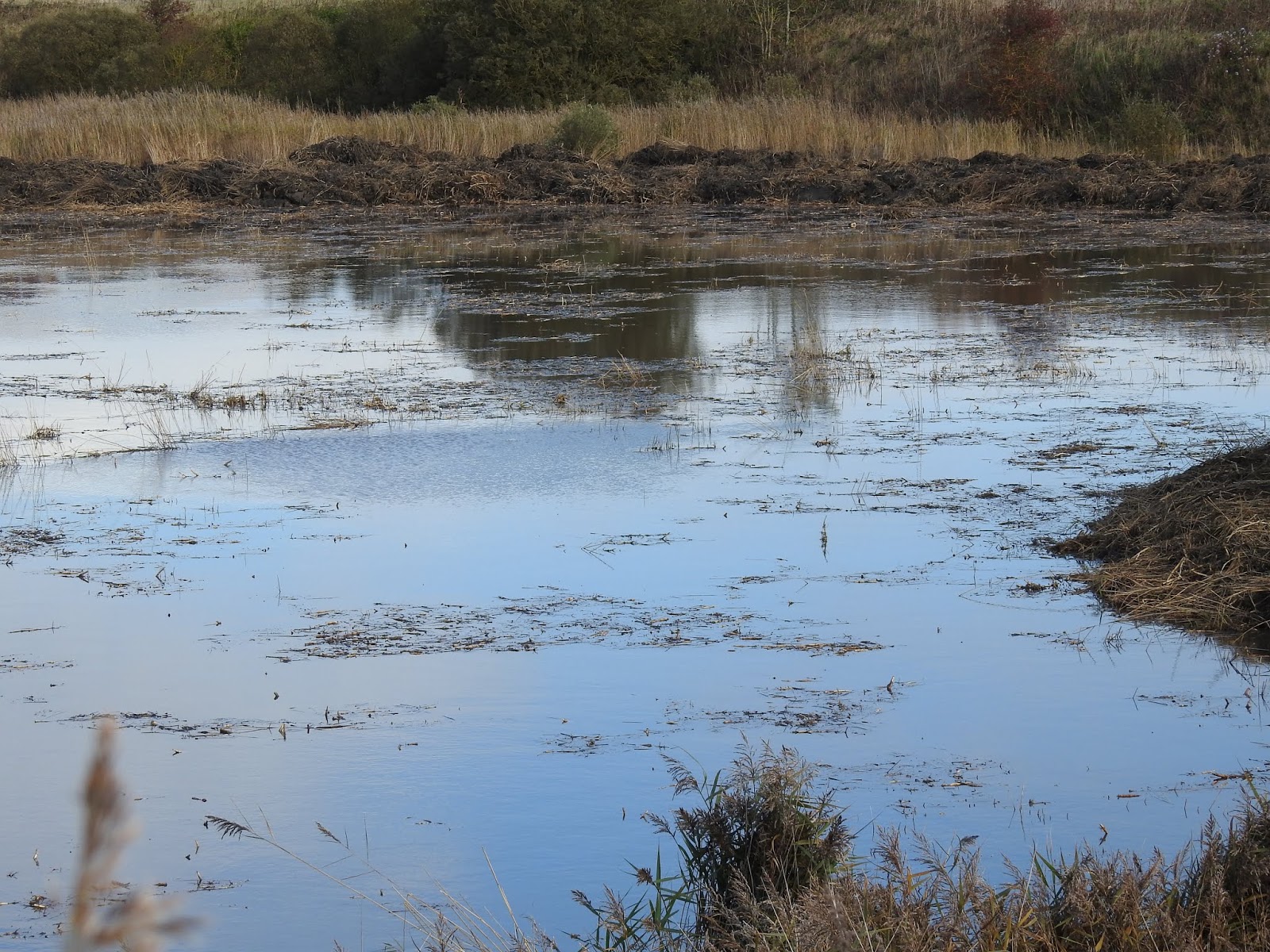
The new scrape (above & below). It looks a bit brutal at the moment, but 
once it has settled a bit it will provide some great habitat for waders and 
wildfowl.


Monday, 21 October 2019

Greenfinch City

At weekend Alice and I had a ringing session at the Obs in the willow scrub and reedbed of one of the wetlands. The morning dawned with clear skies and there was very little wind, perhaps just the hint of a northeasterly.

We got there in the dark with the aim of trying to catch and ring a few Thrushes. We did ring one continental thrush, in the form of Blackbird, but unfortunately the Fieldfares and Redwings weren't playing ball. A handful were attracted to the MP3 players, but that was it.

Greenfinches were the main ringing feature of the morning, and I commented that it was "Greenfinch city", and Alice said is that going to be the title of your Blog, and it is! Because of prior engagements in the afternoon that we both had (me making final arrangements for Gail's birthday party that night), we had to pack up whilst we were still catching, but nevertheless we managed to ring 54 birds as follows (recaptures in brackets):

Cetti's Warbler - 4 (1)
Reed Bunting - 3
Robin - 1
Chaffinch - 2
Greenfinch - 39 (1)
Blackbird - 1
Goldfinch - 1
Blue Tit - 1
Great Tit - 1
Goldcrest - 1
Wren - (1)

 Greenfinch

From a birding perspective because we were busy ringing we didn't see a great deal other than 65 Jackdaws, 580 Pink-footed Geese and a female Stonechat.

I was in north Cumbria carrying out tree assessments all day at several sites and it was obvious that there was quite a large arrival of thrushes as I was seeing mainly Redwings and smaller numbers of Fieldfares at all of the five sites that I visited from Penrith to the Solway to the Northumberland border, and everywhere in between!

Fingers crossed I'll be out for a couple of hours tomorrow morning at the Obs.

Friday, 18 October 2019

Scrapetastic

It was a good vis morning this morning, or should I say it was on the coast where Ian was located, but even over the Nature Park where I was, there was quite a bit of vis, or at least I was hearing a variety of species even though I couldn't see them high up in the stratosphere. More of that later!

Ian and I have been working with Lancashire County Council at the Nature Park, within the Obs recording area, advising on some habitat management works to help improve the biodiversity of the site. Yesterday morning contractors started working on one of the shallow pools, with the aim to open it up by removing the non-native invasive New Zealand pygmyweed Crassula helmsii and areas of encroaching Common Reed. This will make the site more suitable to passage waders and wintering wildfowl.

I visited the Nature Park to see how the contractors doing the work were getting on, and they are doing a cracking job. It should all be finished by the weekend, and then it will be a case of monitoring and seeing how the birds utilise the newly created pools. I've included a few pictures below of the work in progress.


I was only on site for just over an hour and I mentioned that there was some vis. I had lots of registrations of calls, but as the birds were so high I couldn't see them, so the totals produced here are actually quite meaningless, but nevertheless on vis I had eleven Skylarks, four Greenfinches, seven Meadow Pipits, nine Reed Buntings, seven Chaffinches, 730 Pink-footed Geese, six Siskins, 163 Jackdaws, a Rook, a Snipe and three Goldfinches

 Some of the Jackdaws (above & below)


I counted the wildfowl and allies on the pools and there were 45 Coots, ten Tufted Ducks, 23 Mallards, three Mute Swans, three Moorhens and a Little Grebe. Other bits of interest included a Goldcrest, a Water Rail, a Raven and a singing Cetti's Warbler.

 Moorhen

 Tufted duck

The forecast is looking okay for ringing this weekend, and next week high pressure is building and hopefully bringing in more calm conditions suitable for the arrival of some more autumn migrants. Fingers crossed!

Thursday, 10 October 2019

Immersed On The Merse

Earlier this week I had some tree assessments to do in Red Kite country in Dumfries and Galloway, and if you were to draw an imaginary line from Dalbeattie, to Castle Douglas to Balmaclellan at the top of Loch Ken, all of my tree assessments weren't far from this line. And this is well and truly Kite country! In fact driving between my site visits I probably had in the region of 15-20 sightings of Red Kite.

Gail and I had a lovely overnight stay at our regular B & B, Douglas House, that we stay at in Castle Douglas, and the following morning we headed off to Mersehead RSPB for a mornings birding immersed on the merse! As we set off to explore one of our favourite reserves, we had 7 oktas cloud cover with a brisk southwesterly wind.

We headed along the path to the shore on the Solway first of all, and the path takes you between the merse and some extensive grazed pastures frequented by Barnacle Geese, for which the reserve is very important for. If it had been a less windy morning there would quite possibly have been a few migrants in the Gorse hedgerow between the merse and the pasture, but this morning we had to make do with thirteen Long-tailed Tits and a couple of Goldcrests.

Below are a few shots of what is my favourite goose, the Barnace Goose!


In the extensively grazed wet pasture were 609 Barnacle Geese, 140 Lapwings and 400 Teal on the floods. I read later in the day that at the moment there are 700 Barnacle Geese at Mersehead. The path then headed across the merse to the shore, and it was quiet here except for 15 Skylarks, 16 Meadow Pipits and a Reed Bunting. Fly-overs as we walked along were a single Swallow, a Buzzard and a pair of Goosanders.

It was quiet along the shore, but the views along the white shell beach and the Solway were gorgeous and there wasn't another soul other than Gail and I. We reached the woodland that runs from the middle of the reserve to the coast, that always looks good for migrants, but it always seems to be windy when we're here and all we could muster were two more Goldcrests and a couple of Chiffchaffs.

 The Solway shore

We headed to the first hide overlooking the main pool and counted an additional 200 Teal, plus 55 Wigeons and six Pintail. Below are some pictures of the views overlooking the pool from this hide.


We then headed back to the visitor centre, with three Red Admirals along the way, to have a look at the feeding station outside the main viewing window. It was alive with Chaffinches (20) and Tree Sparrows (15), with lesser numbers of Greenfinches (8-10) and House Sparrows (5).

So, nothing amazing, but it was nice to be out on a great reserve in a lovely part of the world.

Sunday, 6 October 2019

Quieter Than Quiet

I was hoping that there would have been a few grounded migrants around yesterday morning, based on the previous night's Redwing movement and on the forecast. During darkness on Friday evening I kept periodically sticking my head outside to have a listen, and noted that Redwings were on the move. Combine that with easterly winds, clear skies and with cloud rolling in pre-dawn it looked like a recipe for a few grounded migrants, not the quieter than quiet morning that ensued!

I called at the Cemetery first of all and it was a tad cold with 7 oktas cloud cover and a 10-15 mph south-easterly wind. I mention the fact that it was a tad cold because sometimes it has to warm up a bit for migrants to start 'jumping about'!

So far so good, except the wind was south-easterly rather than easterly, but that wouldn't matter. Was there any grounded migrants? Answer; not really! A few excitable Robins, 8, and Dunnocks, 5, but that was it. I then headed to the coastal park, and met Ian, and again that was quiet other than three Goldcrests and a flock of six Mistle Thrushes that dropped in.

 Dunnock

Over both sites there was a little vis and this included six Meadow Pipits, three Chaffinches, three Redwings, a Song Thrush (with the Redwings) five Goldfinches, four Linnets, 460 Pink-footed Geese (all NE), two Grey Wagtails, and an Alba Wag. An immature male Sparrowhawk shot through the vegetation of the Coastal Park and that was it!

 Pink-footed Geese

Lots of observers in the northwest have been commenting on the low numbers of vis and a lack of grounded migrants. Along the east and south coasts of the UK birders are recording large numbers of birds, and it has been a record breaking year for Meadow Pipit numbers at many sites, but not here. We can only speculate as to why this is, and probably more of the Autumn needs to unfold before we can make any informed guesses as to what is going on.  

Thursday, 3 October 2019

Slipped Up......Maybe?!

I had checked three forecasts for yesterday morning and they were 2-1 against it being fit for ringing at the Obs. Yesterday morning dawns calm and bright! Had I slipped up? I thought so at the time, but maybe not. I used to rely on the BBC weather forecast and when they got their data from the Met Office they were pretty good. Now they get their weather data and forecast information from a Dutch firm, I think, and it has never been the same. However, the one forecast yesterday morning that suggested it would be fine for ringing was that of the BBC! So, what do I know?

Like I said before, yesterday morning dawned clear and flat calm, although the wind did pick up to a well, err, 5 mph NNW after about an hour! On my way to the Point I called in at the Cemetery, although the weather indicated that it might be more of a 'vis' kind of morning I thought there might be half a chance of a Yellow-browed Warbler, but there wasn't. From a grounded perspective all I had were nine Robins and a couple of Goldcrests.

At the Point I was hoping for a decent passage on vis, particularly after the 'blocking' rain that we had yesterday. It was as clear as a bell out in the Bay, as you can see from the pictures below, but there was very little movement. Without doubt there would have been some movement high up, beyond the range of my hearing and sight, but even still I would have expected to pick up some of the lower birds if there had been a good movement. 


My poor vis totals included nine Meadow Pipits, a Magpie, 545 Pink-footed Geese, two Chaffinches, a Greenfinch, two Siskins, thirteen Skylarks, two Alba Wags, nine Carrion Crows and 32 Jackdaws.

 Pink-footed Geese

The sea was actually quieter with just seven Eiders and an Auk sp.! What's going on? A pair of Stonechats in the dunes were a pleasure to watch as always, and that was it!

I then went to the old Quay to see if there was any butterflies about and I had a Red Admiral and three Painted Lady's. A Little Egret, Peregrine and another Goldcrest filled a handful of lines in my notebook.

 Painted Lady

Fingers crossed for some decent weather over weekend!