It was forecast for some light rain round about first light this morning, so I thought I would check a few coastal hot spots at the Obs for some grounded migrants. But it wasn't to be this morning! The rain had obviously had a blocking effect preventing any migrants getting through from the south.
It was actually quite depressing after checking two good coastal sites and drawing a blank! It wasn't until I walked the dunes that I recorded a soggy male Wheatear! There was a little bit of vis, mainly in the form of Meadow Pipits, and they were setting off across the bay in a northwesterly direction. Some of them were turning round and coming back, and others were continuing on as Walney Island was just visible. I had 43 Meadow Pipits and two Swallows that headed west.
It's going to be a better day tomorrow weather-wise, but still northwesterly. My aim is to get out at first light and have a look on the sea. I'll let you know how I get on!
Friday, 14 April 2017

Close To Home
It made a change to be doing a bird survey close to home yesterday morning and my alarm call was still early, but not ridiculously early as it often is! It was still very cold and for me at least this has made the Spring very slow so far. I had 7 oktas cloud cover with a 10 - 15 mph northwesterly wind.
I am surveying an area of farmland with associated hedges and ponds. It's not an area that I have ever birded in the past, and it's always interesting to go somewhere new. Talking of the slow Spring, there were a few migrants around during the four hours I was on site, but they were thin on the ground. Highlights included five Lapwings, four Reed Buntings, three Buzzards, two Willow Warblers, three Chiffchaffs and a Stock Dove. This isn't my complete list of course, but just a few bits and pieces that were moderately interesting.
We're on day one of a four day weekend and the weather doesn't look amazing for birding over the four days, and even less so for any ringing!
I am surveying an area of farmland with associated hedges and ponds. It's not an area that I have ever birded in the past, and it's always interesting to go somewhere new. Talking of the slow Spring, there were a few migrants around during the four hours I was on site, but they were thin on the ground. Highlights included five Lapwings, four Reed Buntings, three Buzzards, two Willow Warblers, three Chiffchaffs and a Stock Dove. This isn't my complete list of course, but just a few bits and pieces that were moderately interesting.
We're on day one of a four day weekend and the weather doesn't look amazing for birding over the four days, and even less so for any ringing!
Monday, 10 April 2017
Velvet Morning
I was at the Obs for first light again yesterday morning and perched on top of the dunes it was still cold until the sun was high in the sky. I had clear skies with a 10 mph southeasterly wind.
There was a good selection of vis and I had my first Tree Pipits of the Spring. My vis totals (all northeast) were four Tree Pipits, 46 Lesser Redpolls, 49 Linnets, seven Goldfinches, 91 Meadow Pipits, a Chaffinch, 24 Carrion Crows, a Wheatear, five Alba Wags, a Sand Martin, a Siskin, two Swallows, a Tree Sparrow, a Grey Wagtail and a Reed Bunting.
This morning was just the same as the past few mornings in terms of my levels of frustration because of the high flying vis, particularly the Redpolls. Once again they were so high that I couldn't see them, only hear them!
As the tide pushed in there was a few waders on the beach including 79 Ringed Plovers, 42 Sanderlings and 31 Dunlins. There was a steady passage of Knot west, and I presume these birds are heading to the Ribble Estuary to roost; in total I had 460.
The sea was fairly quiet, although I did have my first couple of Sandwich Terns head in to the bay. Other totals included 23 Eiders, eight Cormorants, a Red-throated Diver and eight Common Scoters. Mid-morning I picked up what I thought was a group of five Eiders heading southwest across the bay. I say 'thought' as they were a long way off, but the two males stood out even at that distance. A few minutes later I picked them up again and I could see that it wasn't five Eiders, but three Eiders and a pair of Velvet Scoters! The Velvets came a little closer and then headed west out of Morecambe Bay and into Liverpool Bay.
As expected given the clear conditions grounded migrants were thin on the ground and all I had were six Wheatears and four White Wagtails.
Back home in my moth trap I had six Early Greys, a Light Brown Apple Moth, four Common Quakers, two Plume Moth sp. and a Hebrew Character.
It's looking a mixed bag weather-wise this week and I have nine breeding bird surveys to get in before mid-May, no panic at the moment but I do need the weather to improve to make me feel more comfortable!
There was a good selection of vis and I had my first Tree Pipits of the Spring. My vis totals (all northeast) were four Tree Pipits, 46 Lesser Redpolls, 49 Linnets, seven Goldfinches, 91 Meadow Pipits, a Chaffinch, 24 Carrion Crows, a Wheatear, five Alba Wags, a Sand Martin, a Siskin, two Swallows, a Tree Sparrow, a Grey Wagtail and a Reed Bunting.
This morning was just the same as the past few mornings in terms of my levels of frustration because of the high flying vis, particularly the Redpolls. Once again they were so high that I couldn't see them, only hear them!
As the tide pushed in there was a few waders on the beach including 79 Ringed Plovers, 42 Sanderlings and 31 Dunlins. There was a steady passage of Knot west, and I presume these birds are heading to the Ribble Estuary to roost; in total I had 460.
The sea was fairly quiet, although I did have my first couple of Sandwich Terns head in to the bay. Other totals included 23 Eiders, eight Cormorants, a Red-throated Diver and eight Common Scoters. Mid-morning I picked up what I thought was a group of five Eiders heading southwest across the bay. I say 'thought' as they were a long way off, but the two males stood out even at that distance. A few minutes later I picked them up again and I could see that it wasn't five Eiders, but three Eiders and a pair of Velvet Scoters! The Velvets came a little closer and then headed west out of Morecambe Bay and into Liverpool Bay.
As expected given the clear conditions grounded migrants were thin on the ground and all I had were six Wheatears and four White Wagtails.
Back home in my moth trap I had six Early Greys, a Light Brown Apple Moth, four Common Quakers, two Plume Moth sp. and a Hebrew Character.
It's looking a mixed bag weather-wise this week and I have nine breeding bird surveys to get in before mid-May, no panic at the moment but I do need the weather to improve to make me feel more comfortable!
Saturday, 8 April 2017
Registrations
At first light at the Obs there was a ground frost and I also had a heavy dew in my beard! The skies were crystal clear and it was flat calm. From the outset it was obvious that Redpolls were on the move, but sadly they were up in the stratosphere. It's difficult recording the vis when conditions are this clear as what you are really recording is just registrations. You hear a bird calling high up, you can't see it, so it is just a registration; it could be a single bird, but it could also be a small flock.
There was a supporting cast to the Redpolls and my totals were 100 Lesser Redpolls, 29 Meadow Pipits, seven Goldfinches, eight Linnets, two Woodpigeons, two Carrion Crows, a Greenfinch, five Alba Wags, two Swallows and three Siskins.
The most surprising observation of the morning was two Red-legged Partridges, that were a new species to be recorded at the Obs for me. In fact shortly after I had seen them I caught one of them in a mist net, but it got out before I got to the net. There is an absolute ban on ringing Red-legged Partridges by the BTO so even if I had managed to extract it, it wouldn't have been ringed.
On the subject of ringing I ringed 26 birds as follows (recaptures in brackets):
Meadow Pipit - 1
Lesser Redpoll - 19
Blue Tit - 4
Dunnock - 1
Wren - 1 (1)


It wasn't a grounded morning and in fact I had no grounded migrants at all. The only other observation of interest I had was a female Sparrowhawk that slowly headed north. I couldn't decide whether it was a migrant or not, or just the female of a local breeding pair.
When I got home I checked my moth trap and all I had was a single Hebrew Character, mind you it was cold last night.
I'll be out again in the morning recording any migration, but without mist nets as it looks like it will be a tad breezy for the relatively exposed net rides at the Obs.
There was a supporting cast to the Redpolls and my totals were 100 Lesser Redpolls, 29 Meadow Pipits, seven Goldfinches, eight Linnets, two Woodpigeons, two Carrion Crows, a Greenfinch, five Alba Wags, two Swallows and three Siskins.
The most surprising observation of the morning was two Red-legged Partridges, that were a new species to be recorded at the Obs for me. In fact shortly after I had seen them I caught one of them in a mist net, but it got out before I got to the net. There is an absolute ban on ringing Red-legged Partridges by the BTO so even if I had managed to extract it, it wouldn't have been ringed.
On the subject of ringing I ringed 26 birds as follows (recaptures in brackets):
Meadow Pipit - 1
Lesser Redpoll - 19
Blue Tit - 4
Dunnock - 1
Wren - 1 (1)

Lesser Redpoll (above & below)

It wasn't a grounded morning and in fact I had no grounded migrants at all. The only other observation of interest I had was a female Sparrowhawk that slowly headed north. I couldn't decide whether it was a migrant or not, or just the female of a local breeding pair.
When I got home I checked my moth trap and all I had was a single Hebrew Character, mind you it was cold last night.
I'll be out again in the morning recording any migration, but without mist nets as it looks like it will be a tad breezy for the relatively exposed net rides at the Obs.
Friday, 7 April 2017
A Quick Scamper
I only had time for a quick scamper around the Obs yesterday morning, so I had a quick look on the sea and a search of a couple of spots for grounded migrants. The weather was 4 oktas cloud cover with a west-northwesterly wind about 10 - 15 mph.
Stood on top of the dunes so I could look over the sea and keep an eye out for any passing migrants there was a little bit of vis going on, and everything was heading northeast. I only watched for about an hour and a quarter, so my totals only included a Siskin, 172 Meadow Pipits, eight Carrion Crows, a Goldfinch, five Linnets, four Alba Wags and a Sparrowhawk.
The sea was equally as quiet, or a combination with me not spending long enough, anyway my totals were 25 Common Scoters, four Red-breasted Mergansers and two Whooper Swans. At first I couldn't get a feel as to whether it was a 'grounded' morning or not, but after a while it was obvious that it wasn't as all I had was a Wheatear and a White Wagtail.
Waders were conspicuous by their absence and roosting at high tide were just 101 Turnstones. The forecast is looking good for the next couple of days as the wind swings round to the south and warm air is forecast to surge northwards from Africa. Hopefully it will open a few migrant floodgates and amazingly it looks like the winds will be light enough to get nets up both days over weekend at the Obs!

Stood on top of the dunes so I could look over the sea and keep an eye out for any passing migrants there was a little bit of vis going on, and everything was heading northeast. I only watched for about an hour and a quarter, so my totals only included a Siskin, 172 Meadow Pipits, eight Carrion Crows, a Goldfinch, five Linnets, four Alba Wags and a Sparrowhawk.
The sea was equally as quiet, or a combination with me not spending long enough, anyway my totals were 25 Common Scoters, four Red-breasted Mergansers and two Whooper Swans. At first I couldn't get a feel as to whether it was a 'grounded' morning or not, but after a while it was obvious that it wasn't as all I had was a Wheatear and a White Wagtail.
Waders were conspicuous by their absence and roosting at high tide were just 101 Turnstones. The forecast is looking good for the next couple of days as the wind swings round to the south and warm air is forecast to surge northwards from Africa. Hopefully it will open a few migrant floodgates and amazingly it looks like the winds will be light enough to get nets up both days over weekend at the Obs!

Lesser Black-backed Gull
Wednesday, 5 April 2017
In the Footsteps Of The Premonstratensians
A 4:00 am alarm call yesterday morning was a bit tricky, particularly after just three hours sleep! I had my first of a series of breeding bird surveys to complete in Cumbria and I headed to the top of the county not farm from Carlisle. Driving up there it was quite wet and I did wonder whether I was going to have to call the survey off when I got there, but the BBC forecast was spot on and as the sun rose the rain lifted!
I had three small areas of plantation woodland to survey and for the purposes of the blog I have lumped together the more interesting sightings, or least uninteresting depending on how you look at, and recorded two Great Spotted Woodpeckers, eight House Sparrows, thirteen Fieldfares, three Chiffchaffs, a Song Thrush, two Blackcaps, a Linnet, two Buzzards, seven Siskins, four Stock Doves, a Yellowhammer, a Willow Warbler and a Goldcrest.

The Blackthorn flowering in the hedgerows looked resplendent as did the Primroses in the adjacent woodland and hedge bottoms.


On my way home I called at Shap Abbey to combine my love of natural history with the historic environment, and I always enjoy dropping in to this late 12th century religious house that belonged to the Premonstratensian order of canons. English Heritage look after the abbey with its impressive 15th century tower and other remains. It lies on the coast to coast long distance footpath and is adjacent to the River Lowther, and an area of semi-natural woodland.

The wind had picked up as I set off for my walk around the Abbey, and I expected a few warbler species to be singing from the woodland but all I had were two Goldcrests. The river just held a single Grey Wagtail and Dippers were notable by their absence. A handful of Meadow Pipits and Siskins headed north overhead and that was pretty much everything that I observed of interest.
Fast forward to this morning and on my way to see a client in Bowland I had a Red Kite fly over the road. The bird was heading north and I only saw it for a few seconds, but nevertheless a nice bird to see in Lancashire!

I had three small areas of plantation woodland to survey and for the purposes of the blog I have lumped together the more interesting sightings, or least uninteresting depending on how you look at, and recorded two Great Spotted Woodpeckers, eight House Sparrows, thirteen Fieldfares, three Chiffchaffs, a Song Thrush, two Blackcaps, a Linnet, two Buzzards, seven Siskins, four Stock Doves, a Yellowhammer, a Willow Warbler and a Goldcrest.

There was plenty of evidence of small mammal activity within the newly
planted woodland
The Blackthorn flowering in the hedgerows looked resplendent as did the Primroses in the adjacent woodland and hedge bottoms.

Blackthorn
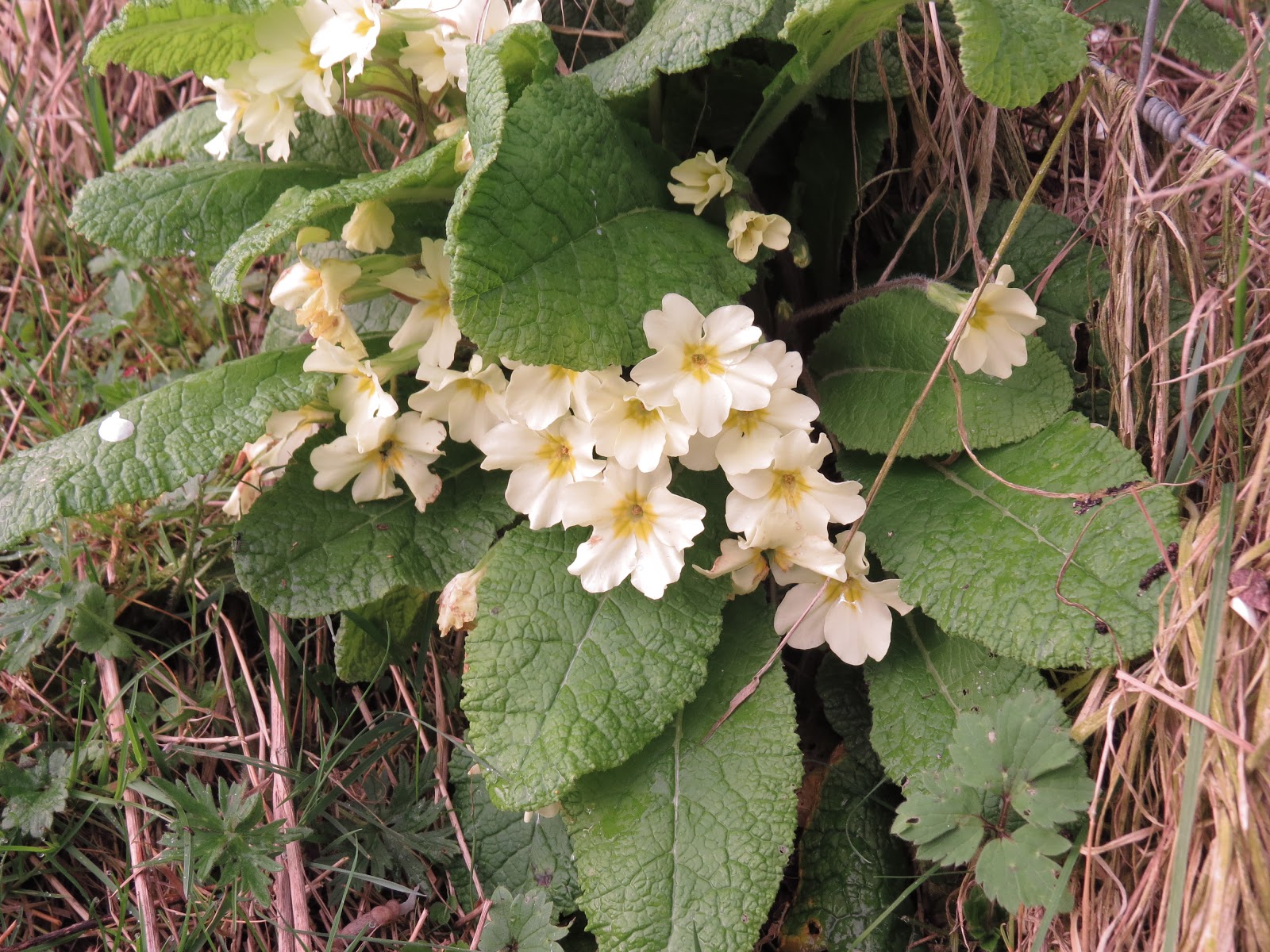
Primrose
On my way home I called at Shap Abbey to combine my love of natural history with the historic environment, and I always enjoy dropping in to this late 12th century religious house that belonged to the Premonstratensian order of canons. English Heritage look after the abbey with its impressive 15th century tower and other remains. It lies on the coast to coast long distance footpath and is adjacent to the River Lowther, and an area of semi-natural woodland.

Shap Abbey
The wind had picked up as I set off for my walk around the Abbey, and I expected a few warbler species to be singing from the woodland but all I had were two Goldcrests. The river just held a single Grey Wagtail and Dippers were notable by their absence. A handful of Meadow Pipits and Siskins headed north overhead and that was pretty much everything that I observed of interest.
Fast forward to this morning and on my way to see a client in Bowland I had a Red Kite fly over the road. The bird was heading north and I only saw it for a few seconds, but nevertheless a nice bird to see in Lancashire!

Robin
Monday, 3 April 2017
Low Level Vis
Yesterday morning dawned with clear skies and a strongish northwesterly wind. As you will know I have a considerable distaste for northwesterly winds as it usually means few or no birds, but this morning was an exception.
From the off it was clear that birds were urgently on the move as they were powering north in to the strong wind. The strong NW wind forced the birds to fly low as wind speeds would be less closer to the ground. Normally in such clear conditions the birds would be very high. Pipits and finches were moving on quite a broad front and I observed them over the farm fields, the beach and even out at sea when I was looking through my scope.
The following totals are really a minimum as it is difficult to count everything. Anyway, I had 165 Linnets, 161 Goldfinches, a Carrion Crow, three Alba Wags, five Siskins, a Redpoll sp., four Swallows, a Sand Martin, two White Wagtails and 835 Meadow Pipits.
It wasn't a grounded morning so two Wheatears and three Goldcrests were acceptable. The sea was quiet, or maybe I wasn't giving it enough attention because of all the vis action, and all I had was two Gannets, a male Eider and a Red-throated Diver! A female Peregrine heading southwest over the fields was also noteworthy.
I then headed to the water treatment works mainly to take down my feeders from the feeding station but also to see if there were any migrants in there as it is away from the coast and sheltered. All I had was three singing Chiffchaffs, and although not migrant birds it was nice to record my first Speckled Wood butterflies of the year.

My garden moth trap this morning held just eight moths; six Hebrew Characters, a Common Quaker and my first Early Grey of the year. It's north Cumbria for a bird survey tomorrow morning for me with a very early start!
From the off it was clear that birds were urgently on the move as they were powering north in to the strong wind. The strong NW wind forced the birds to fly low as wind speeds would be less closer to the ground. Normally in such clear conditions the birds would be very high. Pipits and finches were moving on quite a broad front and I observed them over the farm fields, the beach and even out at sea when I was looking through my scope.
The following totals are really a minimum as it is difficult to count everything. Anyway, I had 165 Linnets, 161 Goldfinches, a Carrion Crow, three Alba Wags, five Siskins, a Redpoll sp., four Swallows, a Sand Martin, two White Wagtails and 835 Meadow Pipits.
It wasn't a grounded morning so two Wheatears and three Goldcrests were acceptable. The sea was quiet, or maybe I wasn't giving it enough attention because of all the vis action, and all I had was two Gannets, a male Eider and a Red-throated Diver! A female Peregrine heading southwest over the fields was also noteworthy.
I then headed to the water treatment works mainly to take down my feeders from the feeding station but also to see if there were any migrants in there as it is away from the coast and sheltered. All I had was three singing Chiffchaffs, and although not migrant birds it was nice to record my first Speckled Wood butterflies of the year.

Speckled Wood
My garden moth trap this morning held just eight moths; six Hebrew Characters, a Common Quaker and my first Early Grey of the year. It's north Cumbria for a bird survey tomorrow morning for me with a very early start!
Subscribe to:
Posts (Atom)