Wednesday, 29 April 2020

Kerrera Tea Garden

I love real ale and I love pubs, but over the years Gail has introduced me to the delights of tea rooms, and in this case a tea garden. I'm not going to abandon real ale and pubs, for coffee and croissants, but if we are out and about watching wildlife, or looking at a historic site, a tea room has become my favoured place for a spot of lunch. Or maybe lunch, then cake and coffee at another tea room later in the afternoon!

A couple of years ago when we were holidaying in Argyll, and staying in a lovely old cottage overlooking Loch Feochan, we spent a day on the delightful island of Kerrera just off the Scottish mainland near Oban. If you ever find yourself in Oban, I can't recommend a day on Kerrera too much, it's a beautiful place.

There are no shops on Kerrera, just the lovely, quirky tea garden. There are no cars either, just glorious peace and quiet, other than the abundant wildlife. You have to walk to the tea garden, and it's located at the southern end of a circular walk route (which I highly recommend), close to the stunning Gylen Castle.

When you get off the small ferry (foot passengers only), and set off on the circular walk there are lots of signs and teapots that guide you to the tea garden. I have posted some of them below.


 Some tasty morsels on the 'specials' board

Gail perusing the menu

On the day we were there we spent the whole day on the island. We had lunch at the tea garden and then headed to Gylen Castle. After we had been to the castle, we detoured back to the tea garden, for cake and coffee in the afternoon. It was that good!

 Gylen Castle (above & below)


I've just pulled my notebook off the book shelf to see what we saw on our circular walk around the southern half of Kerrera and it has reminded me that we saw lots of breeding birds, mainly warblers, chats etc. We did see lots of wildflowers too, but rather ashamedly I didn't make a note of them in my notebook! I was probably too busy looking at the birds and gasping aloud at the stunning scenery!

Anyway, some of the birds that we saw included twelve Willow Warblers, five Song Thrushes (as good as anywhere these days), a Peregrine, a Spotted Flycatcher, four Wheatears (including a female carrying food & a juvenile), two Buzzards, a Blackcap, nine Hooded Crows, a singing Yellowhammer, five Stonechats, four Whitethroats, two Siskins, five Linnets, three Ravens and a Rock Dove!

Some of the views from Kerrera back to the mainland, and to other islands were stupendous.

 Looking north from Kerrera

Back on planet Earth, and back to my lockdown garden bird list, I have added two species since I last updated you; Pied Wagtail and a singing Blackcap. The moth trap has been quiet, mainly because I haven't operated it for a couple of nights because of rain, but yesterday I caught a classic Spring migrant in the form of a Silver Y. It's going to be another wet one tonight, so it might be Thursday night before I run it again.

Sunday, 26 April 2020

Bridge Over The Atlantic

I don't know what's come over me, two posts in two days, I'm back on track...sort of! One of my favourite counties is Argyll, in fact as you know, I love the west of Scotland full stop! For a few years running we had our annual holiday in the Oban area and spent lots of time exploring the surrounding stunning landscape with all its historic sites, beautiful scenery and fantastic wildlife.

The pictures below are of the 'bridge over the Atlantic', or to be correct The Clachan Bridge, that connects the Scottish mainland with the island of Seil. In fact, 'Wild About Argyll' states "cross the Atlantic in less than a minute", and indeed you can!


The bridge spans the Clachan Sound, and because the Clachan Sound connects at both ends to the Atlantic Ocean, and could therefore be considered part of the Atlantic, the bridge became known as the 'Bridge over the Atlantic'.


I can highly recommend a visit to the island of Seil, and the other slate islands such as Easdale and Luing; fascinating history and stunning landscape.

My moth trap has been quiet since the new species for my garden, Lychnis, a couple of days ago. This morning there were just two moths; a Light Brown Apple Moth and a Shuttle-shaped Dart (first for the year). There was kind of three, because a Pug I needed a closer look at escaped before I could get it into a specimen tube for further scrutiny!

Ah well, I'll try again tonight.

Friday, 24 April 2020

Survey Escape

I am one of those people that can't work from home, because the majority of my working time is spent carrying out Ecological surveys, and in the main bird surveys. In addition to this, any survey work that I do for planned development has been classed by the government as essential work.

Yesterday, I had a bit of a survey escape to one of my client's farms, and as I have mentioned before on his Bowland farm I am carrying out a long term survey of the wetlands that he has created, and in addition to this, yesterday's survey also included a walk up to the land managed for breeding waders to see how they are getting on. If any management is required to improve the habitat for breeding waders, these management tweaks will need to be completed at the end of the breeding season for obvious reasons.

So, I had 300 ha, or 3 million square metres, or 600 football pitches to myself, and it was a glorious morning of wall to wall sunshine, with very little wind.

From a breeding wader perspective there was plenty of Lapwings, Curlews, Oystercatchers and a  few Snipe all holding territories. The Oystercatchers were very much associated with the wetland corridor through the centre of the farm, the Curlews on some of the 'rougher' higher land, and the Lapwings on some of the more intensively managed grassland. Lapwings like a short sward, and on some of the land managed for Lapwings I thought they were a tad under-grazed, so that's a tweak to carry out later in the year; graze these areas quite hard in late summer, so that the sward height is right for the following breeding season.

 Lapwing (above & below)


They're not humbugs on the hillside, they're Belted Galloways used for 
conservation grazing

This farm is great for Brown Hares and I must have seen at least twenty individuals on my walk round; magic! As I wandered along the wetland corridor, mapping and counting, I came across two pairs of Stonechats; one close to one of the relatively new pools, and another on an area of unimproved grassland, that is in fact a Biological Heritage Site (BHS).

 Stonechat (pity about the dried rush stem!)

Tufted Ducks breed on the farm, and there are between four and six pairs. A Redstart called from an area of woodland close to one of the 'Tufted' wetlands, and I also had at least twelve singing Willow Warblers from various hedges, copses and small tracts of woodland.

One of the highlights of the morning were two singing Cuckoos, and I managed to see one of them after it flew, being mobbed by Meadow Pipits. I thought it ironic that one or two of these Meadow Pipits will be duped by the female Cuckoo a little later, when they inadvertently raise a Cuckoo chick!

The best of the rest included three Reed Buntings, a Grey Wagtail, three Siskins, a Buzzard and a Tawny Owl.

The moth trap has been very quiet of late, although I did have a new species of moth for the garden this morning in the form of a Lychnis. Sadly, I couldn't get a photograph of it, as when I released it on to some vegetation at the front of my house, it roosted on the under-side of a leaf and I couldn't get any shots! I think that's called Sod's law! It's a belting looking moth, so Google it and have a look. They don't usually appear until mid-late May, so this was an early one.

I'll call it a day now, and go and switch my moth trap on, and pour myself a cold beer!

Tuesday, 21 April 2020

Lockdown Garden Bird List

It's about a week since I had a garden mega, in the form of a Wheatear, and I mentioned the lockdown garden birding competition I was taking part in run by Steve at North Downs & beyond. What I didn't tell you was how many bird species I have recorded so far since the competition started on 20th March.

I have recorded 40 species in, on or over my garden since 20th March as follows:

Mute Swan
Pink-footed Goose
Greylag Goose
Canada Goose
Mallard
Common Scoter
Grey Heron
Sparrowhawk
Common Buzzard
Merlin
Coot
Oystercatcher
Curlew
Common Redshank
Lesser Black-backed Gull
Herring Gull
Feral Pigeon
Woodpigeon
Collared Dove
Magpie
Jackdaw
Carrion Crow
Raven
Blue Tit
Great Tit
Coal Tit
Skylark
Swallow
Starling
Blackbird
Robin
Northern Wheatear
Dunnock
House Sparrow
Meadow Pipit
Chaffinch
Greenfinch
Goldfinch
Siskin
Linnet
Lesser Redpoll

The competition is going to finish on 7th May, to coincide with the end of our second lockdown period. Even if the lockdown period is extended beyond that date, the competition will still finish then. There are a few species I know that are to come, but what's missing? What should I have recorded since 20th March based on previous years? Species I would have expected to have recorded include Cormorant, Black-headed Gull, Great Black-backed Gull, Sand Martin, Wren, Grey Wagtail, Pied Wagtail and Tree Pipit.

On 19th April I recorded a new species of moth for the garden, a Swallow Prominent, and what a stunner it was. See pictures below.


In fact, that was the only moth in my light trap that morning. Since then it has been very quiet, because it has been very cold at night, and this morning all I had was a single Hebrew Character.

I didn't have anything in my moth trap yesterday, because I didn't run the trap, as I was out on a bird survey for work, and there wasn't much to report there either.

The trap will be getting switched on shortly, so fingers crossed for some moths in the morning, and might be able to report on some breeding wader work later in the week. 

Sunday, 19 April 2020

Blocking

Earlier in the week the forecast looked quite interesting for Saturday (18th) morning; an easterly wind with a weather front moving north, that potentially could bring some rain in before first light. Thoughts of a fall occurred! However, by Friday evening the forecast had changed, and the weather front was likely to stall around Cheshire, and peter out. In fact, creating a 'blocking' effect for migrants, and this is what happened.

I took my walk around the coastal farm fields again, and as soon as I started to walk along the sea wall, I knew it would be quiet; no Wheatears! At this time of year Wheatears are quite a good barometer for grounded migrants, and a lack of them along the coast normally means a lack of grounded migrants generally.

Having said that it is Spring, and even though I would class it as a 'trickly Spring' as far as migrants are concerned, it means that some migrants will still trickle through, and yesterday was a case in point.

I stopped for a sea watch and there was some movement at sea including 39 Sandwich Terns, 20 Gannets, 35 Common Scoters, three Cormorants, ten Shelducks, two Red-breasted Mergansers, a Great Crested Grebe, two Arctic Terns, a pair of Eiders, an Auk sp. and a Red-throated Diver.

 A male (above) and female (below) Shelduck stopped off briefly, probably
looking for suitable nest sites.


At this time of year there are always waders moving at sea, and I had eight Whimbrels head north and 200 Knot head south. An Atlantic Grey Seal again, was a pleasure to see.

The best bird I had at sea was a Hooded Crow. I picked up a bird about half way out, heading south, and I thought "what's this, it looks a bit like a Hoodie". I zoomed up my scope, and sure enough it was a Hooded Crow heading south rather purposefully. I watched it south until I lost it, and it never came any closer to shore. Where it was from, or where it was heading to, I'm not sure. Whether it had come from Ireland/western Scotland/Isle of Man, and was heading to Wales, is a possibility.

On my way home I called in very briefly at the Cemetery. As soon as I stepped out of my car, I could hear a Redstart calling. I headed to where the call was coming from and just caught the glimpse of a male flying away, and over in to the bordering gardens. Two Willow Warblers also made it on to the trickly Spring grounded list!

Saturday, 18 April 2020

Catching Up

I'm catching up for two reasons; the first is catching up my blog, and the second is catching up with some summer migrants at last!

Yesterday morning I visited the farm fields on the coast close to home, and I had a walk under 1 okta hazy cloud, with a 10 mph easterly wind. First up were two male Wheatears on the sea wall, and I thought that it looked good for a few grounded migrants. However, that wasn't to be as the only other grounded migrant I had was a singing Lesser Whitethroat, my first for the year.

 Wheatear

As I was walking behind the sea wall it would have been rude not to spend some time having a look on the sea, and also count any vis that might go over. There was some activity at/on the sea in the form of 31 Sandwich Terns, 21 Gannets (including eleven birds roosting on the sea), two Shelducks, 3 males & 1 female Eider, three Cormorants, five Auk sp. and a Razorbill. In addition to the birds was a single Atlantic Grey Seal.

 Sandwich Tern

The vis was nearly non-existent as all I had was five Meadow Pipits, two Linnets, two Alba Wags, a Tree Pipit and two Swallows.

On my way home I called in at the pools briefly, mainly to have a look on the scrape, and I caught up with some more summer migrants, namely Sand Martin, Whitethroat, Reed Warbler, Yellow Wagtail (1 north), Sedge Warbler and White Wagtail (1 north).

On the wildfowl and waterbird front were 18 Tufted Ducks, the male Shoveler that displays to the Tufteds, and two pairs of Great Crested Grebes.

 Male Shoveler showing how the iridescent green head (above) can 
sometimes look blue (below)


The major excitement was a female Marsh Harrier that flew. I picked it up just before the Gulls did coming from the south, and as it crossed over the main pool (there's three) it veered round and looked as if it was going to perhaps hunt over the reedbed. That was until the Gulls picked it up, and she was escorted north off the site with a large 'Larid' entourage!

Below are a coupl of record shots of the Marsh Harrier, with a few of the Gulls giving chase!


In case you have been wondering what I have been having in my garden moth trap recently, it's been quiet:

- 16th - a Common Plume and three Early Greys.
- 17th - three Hebrew Characters and two Common Quakers.

The temperatures might be slowly rising as we get into next week, so hopefully I should have a few more species and numbers of moths to report on!

Wednesday, 15 April 2020

Garden Mega

I don't keep lists of birds that I have seen, and I am not criticising those that do, but I have no idea what my life list is, how many birds I have seen in the UK, or even year lists. However, I do keep a garden list for birds and moths. Why just my garden, and why just those taxa I don't know.

I had to tidy my garden list up recently so I could enter a lockdown garden birding competition organised by Steve Gale over at North Downs & Beyond , and I can tell you that up until today I have recorded 69 species of birds from my garden. So that could include birds foraging or nesting in the garden, flying over, or even just heard calling at night. In fact, I have listed all the birds I have recorded below:

Mute Swan
Pink-footed Goose
Greylag Goose
Canada Goose
Mallard
Common Scoter
Grey Heron
Cormorant
Sparrowhawk
Common Buzzard
Kestrel
Merlin
Coot
Oystercatcher
Northern Lapwing
Dunlin
Common Snipe
Curlew
Common Sandpiper
Common Redshank
Black-headed Gull
Mediterranean Gull
Lesser Black-backed Gull
Herring Gull
Great Black-backed Gull
Feral Pigeon
Woodpigeon
Collared Dove
Common Swift
Great Spotted Woodpecker
Magpie
Jackdaw
Rook
Carrion Crow
Raven
Blue Tit
Great Tit
Coal Tit
Skylark
Sand Martin
Swallow
House Martin
Long-tailed Tit
Common Chiffchaff
Willow Warbler
Sedge Warbler
Blackcap
Goldcrest
Wren
Starling
Blackbird
Fieldfare
Song Thrush
Redwing
Mistle Thrush
Robin
Dunnock
House Sparrow
Tree Sparrow
Grey Wagtail
Pied Wagtail
Tree Pipit
Meadow Pipit
Chaffinch
Greenfinch
Goldfinch
Siskin
Linnet
Lesser Redpoll

Why are you telling us all this, I can hear you say? Well, it's by way of an introduction to yesterday's garden mega!

During the lockdown period, and indeed whenever I am working in my home office, I stop every thirty minutes or so and spend five minutes in the garden looking skywards.

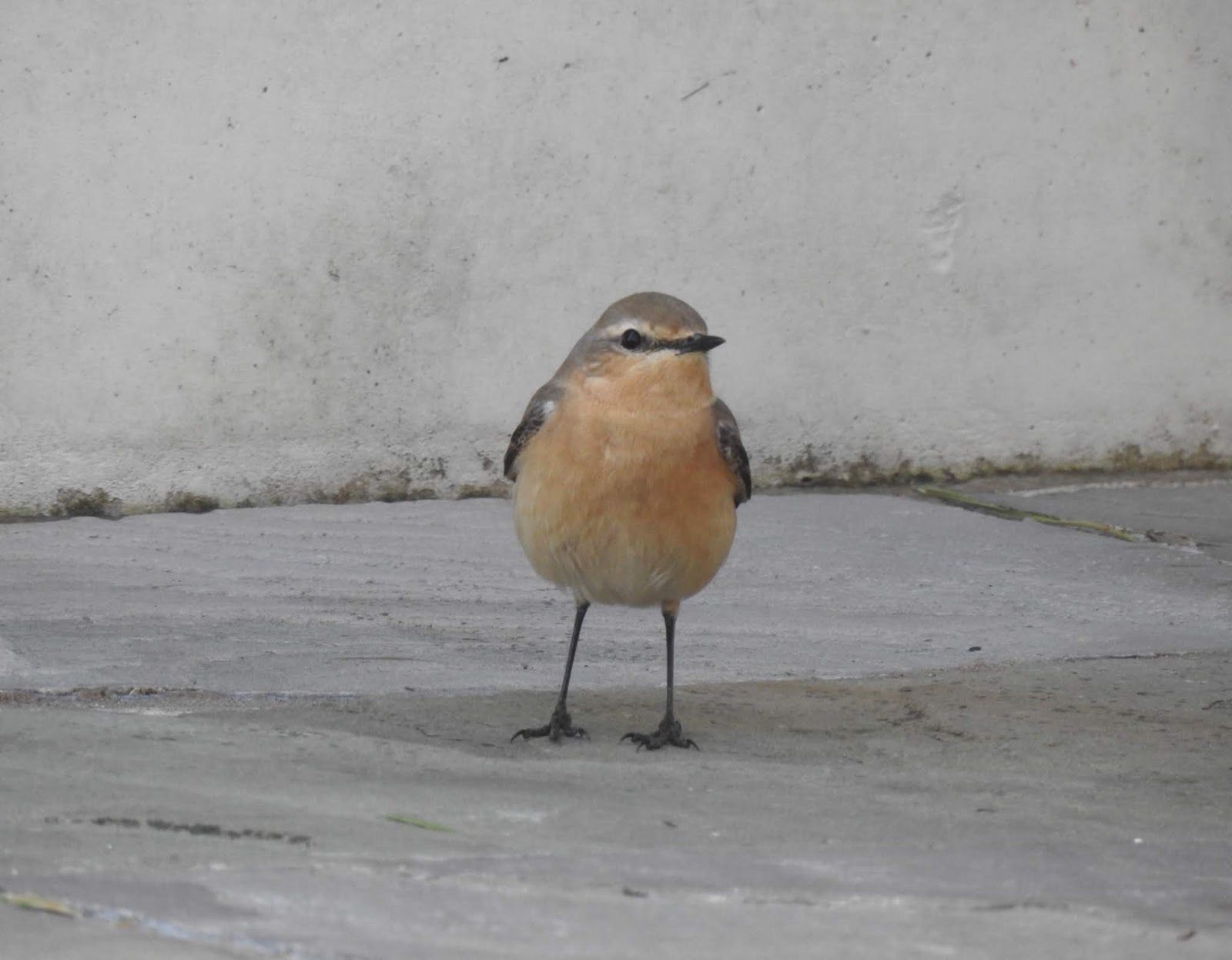
I was already pleased with a Raven over earlier in the morning, but at 10:00 a.m. when I walked to the end of the garden (a short walk) and looked back at my house, I could see a passerine perched on top of my roof. It was silhouetted against the bright blue sky, so I couldn't see with the naked eye what it was. I thought it looked 'odd', so I lifted my bins to check it out, and I was amazed to see that it was a female Wheatear! A female Wheatear perched on the roof of my house - mega!!!


Now Wheatears are not rare by any means, and are a very common migrant in spring and autumn on the coast close to home. But what on earth was a Wheatear doing on my roof in crystal clear conditions at that. You might understand it if it had been a dreich sort of day, and the weather had grounded it, but it was glorious.

Needless to say, this was a first record for the garden, taking me to 70 species. I took a few shots of the Wheatear from both the front and back of my house, and the shots were better from the front as the sun was slightly behind me in this position.


By this time, I had given Gail a shout, and she came out to enjoy the Wheatear. Even Gail was a bit excited! Whilst we were watching it, it flew down towards the ground towards my next-door neighbour's front garden. I looked along the lane from my gateway and it was attempting to feed on the pavement by picking up berries.


This gave me a clue as to why it was perched on top of my house. I suspect that it had been migrating most of the night in clear conditions with a light south-easterly wind, and when the day dawned it carried on in the clear conditions, probably until it was out of fuel (fat reserves), and then it just pitched down where it was. This to me explains why it was investigating unsuitable food types like berries. It also looked a tad miserable, if a bird can look miserable.


It then moved on to my neighbour's drive, and that was where I left it. I checked again half an hour later, and it was gone. So, I hope it found some food, and moved at least to a more suitable foraging area. It's funny how such a common bird, out of context, can cause so much excitement!


In case you have been wondering what's been in my moth trap over the past few days, it's been quiet. On Monday (13th) there were just four Hebrew Characters, yesterday just two Hebrew Characters and this morning (15th) two Hebrew Characters and an Early Grey.

I don't think I'll be able to beat yesterday's Wheatear, but I will be looking!